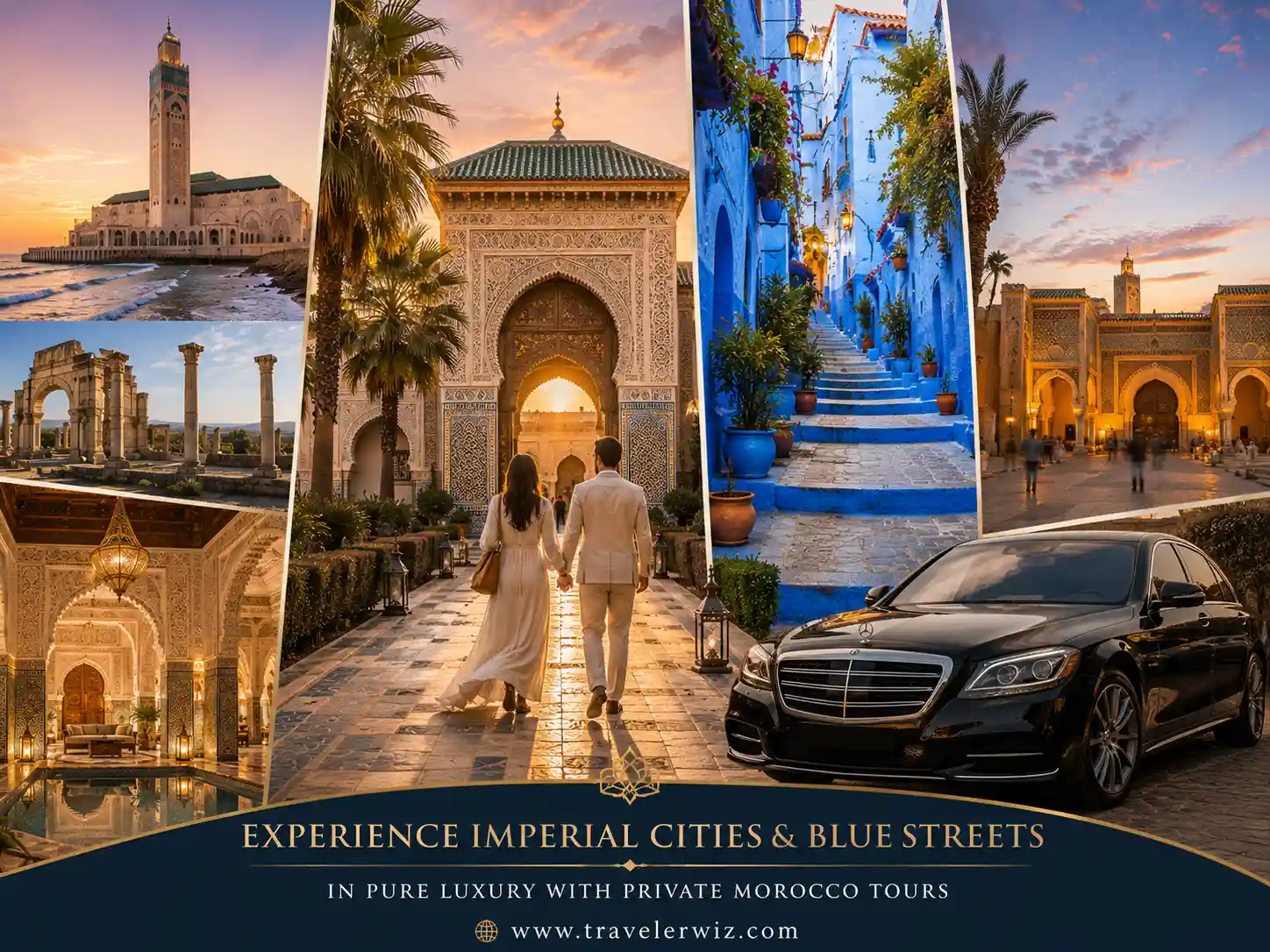
Experience Imperial Cities & Blue Streets in Pure Luxury With Private Morocco Tours

Sponsored Content: This article was submitted by a paid partner. TravelerWiz maintains editorial independence, and paid links within this content are marked accordingly per search engine guidelines.
Morocco is definitely one of those countries that is worth the effort of exploring it thoroughly. You might have enjoyed a mint tea in the presence of the view of the colorful maze of the souks of Marrakech from the roof of your hotel, but now you can explore the maze of the alleys of Fes, with centuries of history breathing down on your neck.
The royal monuments of Rabat, the magnificent splendor of the imperial city of Meknes and the mysterious blue streets of Chefchaouen are definite must-visit locations.
But, group tours often fail to appreciate the beauty due to lack of time.
If you want to explore its rich history and breathtaking landscape on your own then private tours like Tilila Travel would be the best choice. In this blog, I’ll share the best time to visit Morocco, top destinations to explore without the headache of managing logistics. Let’s get straight to the topic.
| Destination | Best Time to Visit | Average Temperature | Top Attractions | Ideal Stay |
| Marrakech | March–May, September–November | 18°C–32°C | Jemaa el-Fnaa, Majorelle Garden, Bahia Palace, Souks | 2–3 Days |
| Fes | March–May, September–November | 15°C–30°C | Fes el-Bali, Al-Qarawiyyin, Bou Inania Madrasa, Chouara Tanneries | 2–3 Days |
| Rabat | April–June, September–October | 17°C–27°C | Hassan Tower, Royal Palace, Kasbah of the Udayas, Atlantic Coast | 1–2 Days |
| Meknes | March–May, September–November | 16°C–29°C | Bab Mansour, Royal Stables, Moulay Ismail Mausoleum, Volubilis Excursions | 1–2 Days |
| Chefchaouen | April–June, September–October | 15°C–28°C | Blue Medina, Spanish Mosque, Kasbah Museum, Rif Mountain Trails | 2 Days |
Here’s a quick tip: if you’re planning your Morocco trip, make sure you plan in Spring or Winter when temperature is pleasant. Because Morocco heat is a real thing that won’t let you go outside.
What Are the Core Pillars of a Luxury Moroccan Journey
There’s much more to Luxury Private Tours in Morocco than fancy hotels. Ease of travel, luxury lodging and access to the most desired experiences in the country.
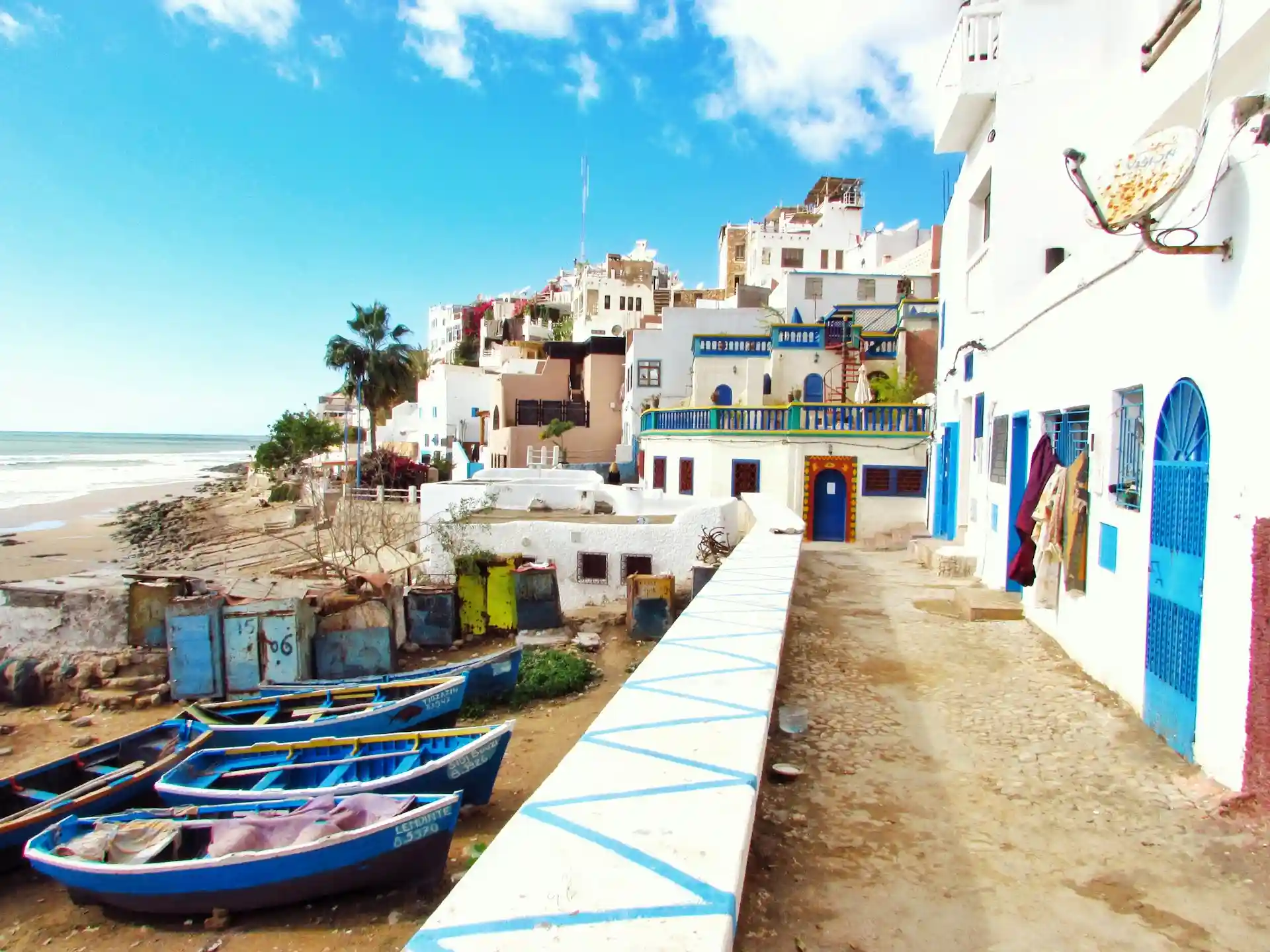
Each element is thoughtfully designed to allow for relaxation and authenticity to the Moroccan landforms, history and culture.
- Drive to destinations within a private climate controlled Mercedes
- Enjoy the serene courtyards, plunge pools, luxurious suites and personal service provided in riads.
- Discover Morocco’s most iconic landmarks with licensed local historians
How Much Does a Luxury Private Morocco Tour Cost?
One of the first questions every traveler asks — and the one most Morocco tour websites deliberately avoid answering. Tilila Travel believes in transparency from the first conversation, so here is exactly what a luxury private Morocco tour costs and what that price includes.
Luxury private Morocco tours typically range from $250 to $450 per person per day, depending on your accommodation tier, group size, and the season you travel. The more guests sharing the private vehicle and guide, the lower the per-person cost — a couple pays more per person than a family of four, but experiences exactly the same level of service.
Here is what that translates to across the most popular Tilila Travel itineraries:
| Tour Type | Group | Duration | Approx. Cost Per Person |
|---|---|---|---|
| Imperial Cities classic | Couple | 7–8 days | $2,800 – $3,600 |
| Imperial Cities + Chefchaouen | Couple | 8–10 days | $3,200 – $4,200 |
| Imperial Cities + Sahara | Couple | 10–12 days | $3,800 – $5,000 |
| Family of 4 (luxury riads) | Family | 10 days | $3,000 – $4,200 per person |
| Honeymoon (Royal Mansour tier) | Couple | 7–8 days | $4,500 – $6,500 |
| Senior private tour | Couple | 7 days | $2,800 – $3,800 |
*All prices are approximate. Final pricing depends on accommodation selection, travel dates, and specific activities requested. Contact Tilila Travel for an exact quote built around your itinerary.
What Is Included and What Is Not
The single most important thing to clarify before comparing Morocco tour prices is what each one actually covers. A $200/day quote that excludes accommodation, guides, and transfers is not the same product as a $350/day quote that includes all three.
Here is exactly what a Tilila Travel luxury private tour includes — and what falls outside the package:
| ✅ Included | ❌ Not Included |
|---|---|
| Private climate-controlled vehicle (Mercedes or equivalent) with professional driver throughout | International flights to and from Morocco |
| Licensed local historian/guide in each Imperial City | Moroccan visa (not required for US, UK, EU, Canada, Australia) |
| Luxury riad or 5-star hotel accommodation (named properties, not “a boutique riad”) | Travel insurance (strongly recommended — ask us for preferred providers) |
| Breakfast daily at your riad | Monument and museum entry fees (typically $2–$8 per site) |
| Most lunches and dinners at curated restaurants | Tips for your driver and guides (see tipping guide below) |
| All inter-city transfers and airport pickups | Optional add-ons: cooking classes, hammam treatments, camel treks |
| 24/7 WhatsApp access to your Tilila Travel contact | Personal shopping purchases |
| Pre-trip itinerary consultation and customization | Alcoholic beverages (available at all luxury riads and most restaurants) |
Why Two Morocco Tour Quotes Can Look the Same But Be Completely Different
The most common frustration among luxury Morocco travelers — shared repeatedly in reviews of other operators — is arriving to find their “luxury riad” is a converted guesthouse with shared bathrooms, or their “private tour” includes two other couples they have never met.
Tilila Travel operates differently on three specific points that matter most to luxury travelers:
Named accommodation, confirmed before you book. Your itinerary specifies the actual property — Royal Mansour Marrakech, Riad Fes Relais & Châteaux, Four Seasons Rabat — not “a luxury riad in Marrakech.” You can verify every property on TripAdvisor, Condé Nast Traveler, or The Leading Hotels of the World before committing. No surprises on arrival.
Genuinely private, always. Your vehicle, your driver, your guide, your schedule. Not “small group private” or “private upgrade available.” You will never share your transfer, your table, or your day with travelers you did not choose to travel with.
Locally owned and operated in Morocco. Tilila Travel is based in Morocco — not a London or New York reseller outsourcing your trip to a ground operator you never speak to. When you contact us, you are speaking directly to the people who will be on the ground with you.
Is a Luxury Private Tour Worth the Investment?
The honest answer is that Morocco is one of the few destinations where the difference between a private tour and a group tour is not a matter of comfort — it is a matter of access. The Chouara Tannery at 7am from an exclusive terrace before any other tourists arrive is a different experience from the Chouara Tannery at 11am from a street-level leather shop.
Majorelle Garden at 8am with your guide is a different experience from Majorelle Garden at 10am in a group of forty. Fes el-Bali with a private historian who has walked those 9,000 streets for twenty years is a different city from Fes el-Bali with a shared guide counting heads.
Morocco rewards depth. Private tours are the only format that allows it.
→ Request your custom itinerary and pricing from Tilila Travel
The Majesty of the Imperial Cities
The Imperial Cities of Morocco are historic capitals which tell the history of the kings of Morocco. Scroll down to find about these cities in detail:
Marrakech: The Red City of Energy and Elegance
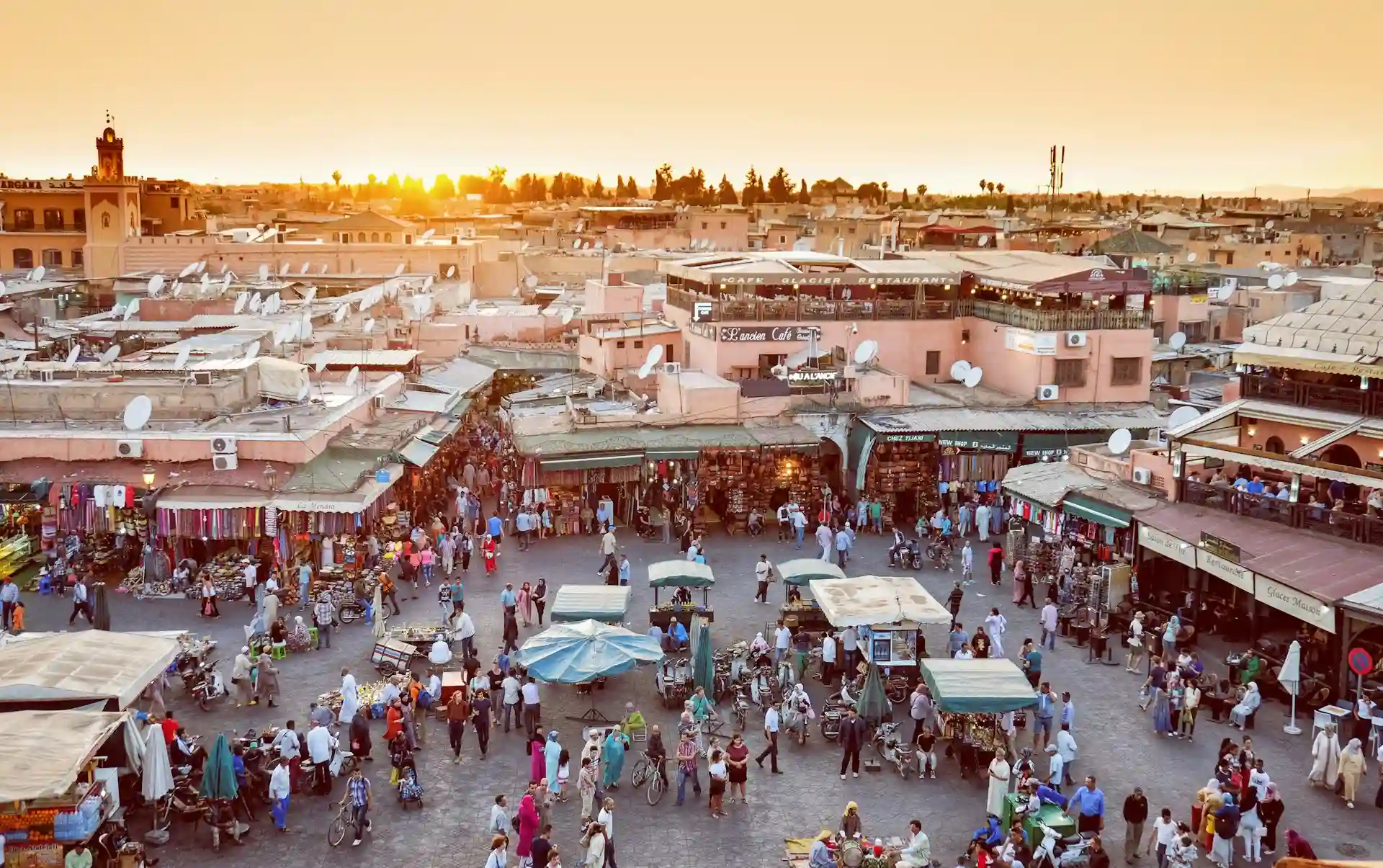
Dating back to 1070 when it was founded by Yusuf ibn Tashufin, Marrakech became the capital of the Almoravid and Almohad empires.
The soul of the city is definitely its central square – Jemaa el-Fnaa. Private tours ensure a balcony seat to view the market theatre in all its colour from a distance.
The renowned Majorelle Garden, designed by French artist Jacques Majorelle in 1923 and rescued by fashion icon Yves Saint Laurent, can always be counted on to have long lines. The luxury itineraries allow you to enjoy access to the paths before the masses and enjoy it in a VIP style.
With a private Tilila Travel tour, you will be shown the way to the best leather, the hand-woven rugs and the rare spices at true local prices, through the maze of the winding markets.
Where Tilila Travel guests stay in Marrakech
Marrakech has more luxury accommodation than any other Imperial City, and the range between properties is enormous. Tilila Travel works with three tiers depending on your budget and travel style.
At the pinnacle: Royal Mansour Marrakech — a private medina within the medina, commissioned by King Mohammed VI and opened in 2010. The property comprises 53 individual private riads, each with its own rooftop plunge pool, private garden, and a dedicated butler who moves invisibly through an underground network of tunnels so your privacy is never interrupted. Three restaurants include a table by Hélène Darroze, the two-Michelin-star French chef. Royal Mansour ranked 13th in The World’s 50 Best Hotels 2025. For guests who want the finest address in Morocco, there is no equivalent.
La Mamounia is Marrakech’s other landmark property — a 1923 palace hotel set in 8 hectares of olive and orange gardens directly adjacent to the medina walls. Voted #1 Hotel in Africa and #11 Best Hotel in the World in the 2024 Condé Nast Traveler Readers’ Choice Awards. The 2,500 m² spa has two traditional hammams plus a private hammam suite for couples — the full Moroccan ritual of black soap, kessa exfoliation, and rhassoul clay applied by a traditional tayeba is one of the defining experiences of a Marrakech stay.
For guests seeking outstanding quality at a more accessible price point, El Fenn (founded by Vanessa Branson, sister of Richard Branson — 28 rooms across interconnected riads with two rooftop pools and a genuine art collection throughout the property) and Villa des Orangers (Relais & Châteaux, 27 rooms around three private courtyards, within walking distance of the Jemaa el-Fnaa) both deliver genuine luxury without the ultra-premium price tag of Royal Mansour or La Mamounia.
Insider access your private guide provides in Marrakech: Early morning entry to Majorelle Garden before the first tour buses arrive — the light on the cobalt-blue walls at 8:30am is unlike anything you will experience after 10am.
A private rooftop dinner above the Jemaa el-Fnaa, watching the square transform from a market into an open-air theatre below you. And in the souks, a direct introduction to the artisan workshops behind the market stalls — the weavers, leather workers, and spice merchants who supply the shops but never deal directly with tourists.
Fes: The Cultural Capital of Living History
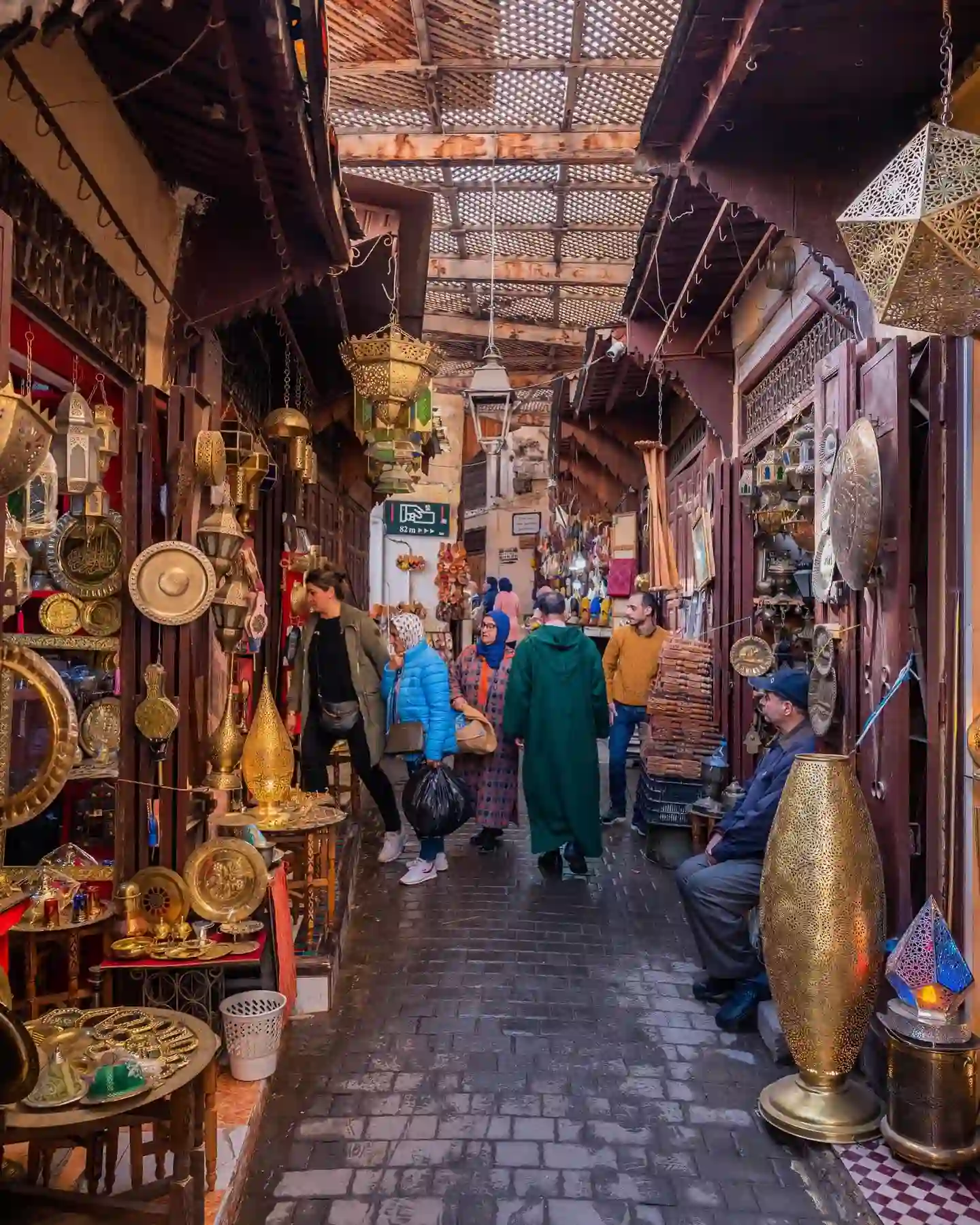
Fes is the oldest Imperial city, which was founded by Idriss I in 789 AD, and has the oldest university in the world that is still operating – the University of al-Qarawiyyin.
Fes el-Bali is an old city with over 9,000 narrow streets. This maze is accompanied by a private historian who will show you the wonderful Islamic school of the 14th century, the Madrasa Bou Inania.
The tanneries are open air tanning sheds, where leather is tanned in the same fashion as it was done since the 11th century. Private tours won’t pass through the noisy shops on the street, but take the guests to the exclusive elevated viewing balconies that provide the best photographs and new mint leaves to refresh the senses.
Where Tilila Travel guests stay in Fes
Fes has fewer internationally branded luxury properties than Marrakech, which makes the selection of riad more important here than anywhere else on the route. The wrong riad in Fes is genuinely uncomfortable — narrow alleyways, no natural light, poor ventilation. The right one is one of the most memorable stays in Morocco.
Riad Fes — Relais & Châteaux is the standout property and the only Relais & Châteaux-branded riad in Fes. Set in a 19th-century merchant’s palace in the heart of Fes el-Bali, the hotel has 30 rooms and suites arranged around a central courtyard, a rooftop pool with direct views over the medina and the Atlas Mountains beyond, and a Spa Cinq Mondes offering traditional Moroccan hammam treatments alongside contemporary therapies. The rooftop at dusk — medina panorama in every direction, mountains in the distance, the call to prayer rising from hundreds of minarets simultaneously — is one of the most complete sensory experiences in Morocco.
Palais Faraj is the alternative for guests who want more contemporary luxury within a historic shell: a restored 19th-century palace with 25 individually designed suites, a hillside infinity pool overlooking the medina, and a Givenchy-inspired spa. The terraces here provide some of the best unobstructed tannery views in Fes without leaving the property.
Hotel Sahrai suits guests who prefer modern 5-star luxury to riad character: a contemporary hilltop design hotel built on the former site of Marshal Lyautey’s summer palace, with an infinity pool, Givenchy Spa, and a panoramic restaurant perched above the medina. The architecture is striking — clean lines, Moroccan materiality, none of the labyrinthine quality of the medina below. Ideal for guests who find the medina exhilarating during the day but want visual and physical separation from it at night.
The tannery visit your private tour makes possible: Tilila Travel routes guests directly to the elevated terrace of Shop 10 at Chouara Tannery — the single best aerial view of the dyeing pits in full operation, bypassing entirely the street-level leather shops where commission-based “free guides” push purchases. The best time is 10:30am to 2:00pm when the vat colors are most vivid and workers are most active. The mint sprig offered at the entrance is not a tourist prop — the soaking pits (pigeon droppings, quicklime, and ammonia are part of the tanning process) produce a genuine smell, and the mint makes it manageable. Take it.
Rabat: Coastline Monuments and Modern Royalty
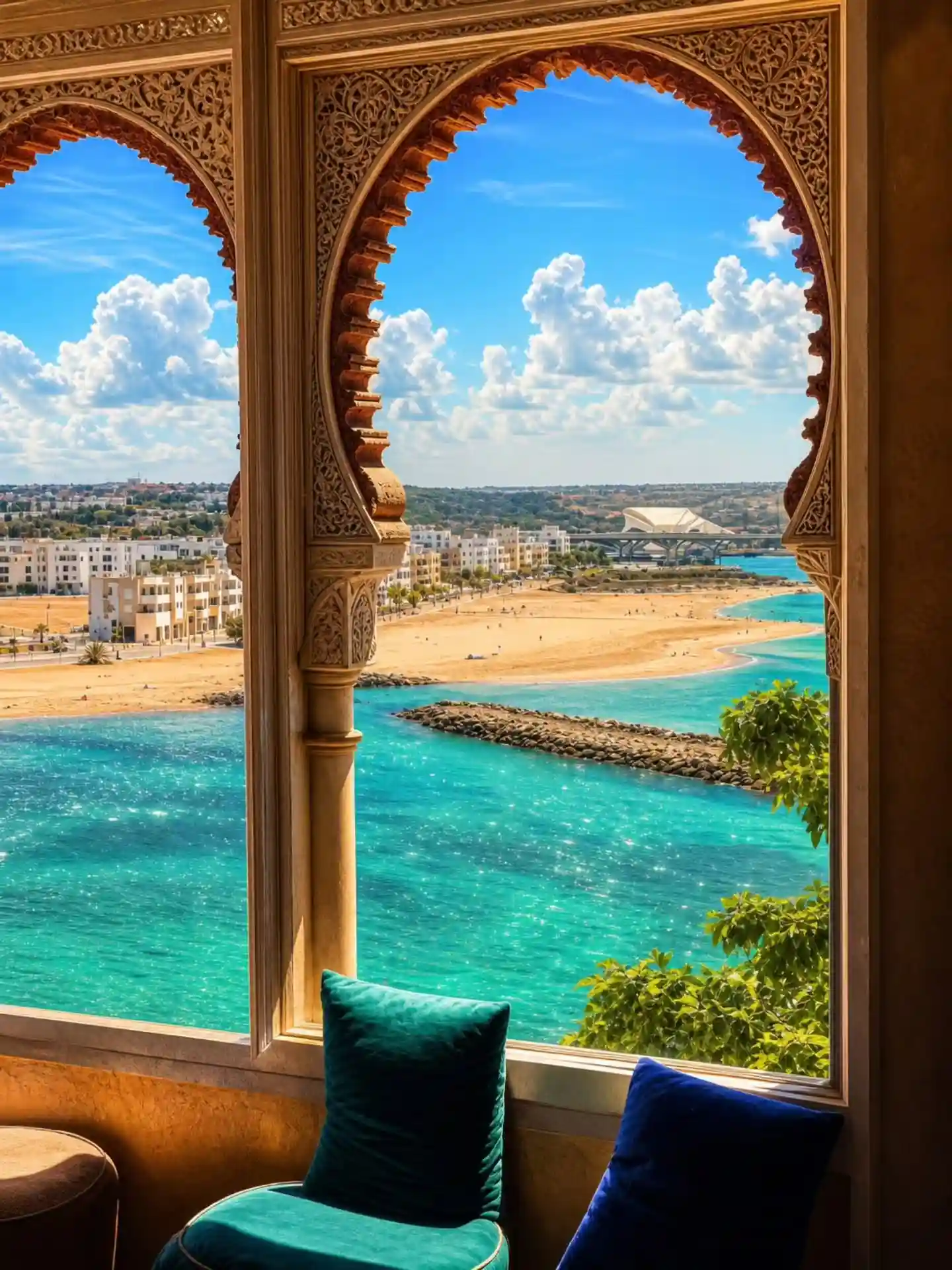
The city of Rabat was established in the 12th century, and it is now the National Capital of Morocco, located beautifully on the shores of the Atlantic ocean. The extensive and modern streets and buildings are easily navigable by private transport.
The famous tower of Hassan, unfinished red sandstone tower abandoned in 1199 and the adjacent Royal Palace will be seen. Unlike other destinations, there aren’t as many groups of tourists at Rabat, so there’s plenty of time to absorb the details of the intricate marble architecture, and the royal guards without being rushed.
Where Tilila Travel guests stay in Rabat
Rabat received two landmark luxury hotel openings in 2024 and 2025 that transformed what was Morocco’s most underserved Imperial City for luxury accommodation into one of its best.
Four Seasons Hotel Rabat at Kasr Al Bahr sits directly on the Atlantic shore — the only Imperial City hotel where you wake up to the sound of the ocean. The property has 200 rooms across historic and modern buildings on 12 oceanfront acres, a rooftop infinity pool that appears to extend directly into the Atlantic, and a signature Sultan’s Riad two-story suite with its own private rooftop pool. For guests who want to understand why Rabat residents consider their city the finest place to live in Morocco, this is the property that makes the argument visually.
The Ritz-Carlton Rabat, Dar Es Salam opened in September 2024 in the oak forests near the Royal Golf Dar Es Salam estate. The property has 117 keys, a Romanesque indoor pool, six restaurants and bars, and a spa that uses traditional Moroccan ingredients — argan oil, ghassoul clay, rose water — across treatments designed around the hammam ritual. The location feels removed from the city while remaining 15 minutes by private car from the main attractions.
La Tour Hassan Palace is Rabat’s historic grand hotel — a 1912 Moorish-Andalusian landmark within walking distance of Hassan Tower, preferred by guests who want the most central location and a property that has hosted every significant visitor to Morocco’s capital for over a century.
The Rabat experience your private tour provides: A private crossing of the Bouregreg River by traditional barcasse to the old medina of Salé — a neighborhood completely free of tourist infrastructure and commission shops — followed by a guided walk through streets where you will encounter no other foreign visitors. At the Oudayas viewpoint at sunset, where the river meets the Atlantic Ocean, your guide steps back and lets the view speak without commentary. It is the quietest and most affecting moment on the entire Imperial Cities route.
Meknes: The Moroccan Versailles
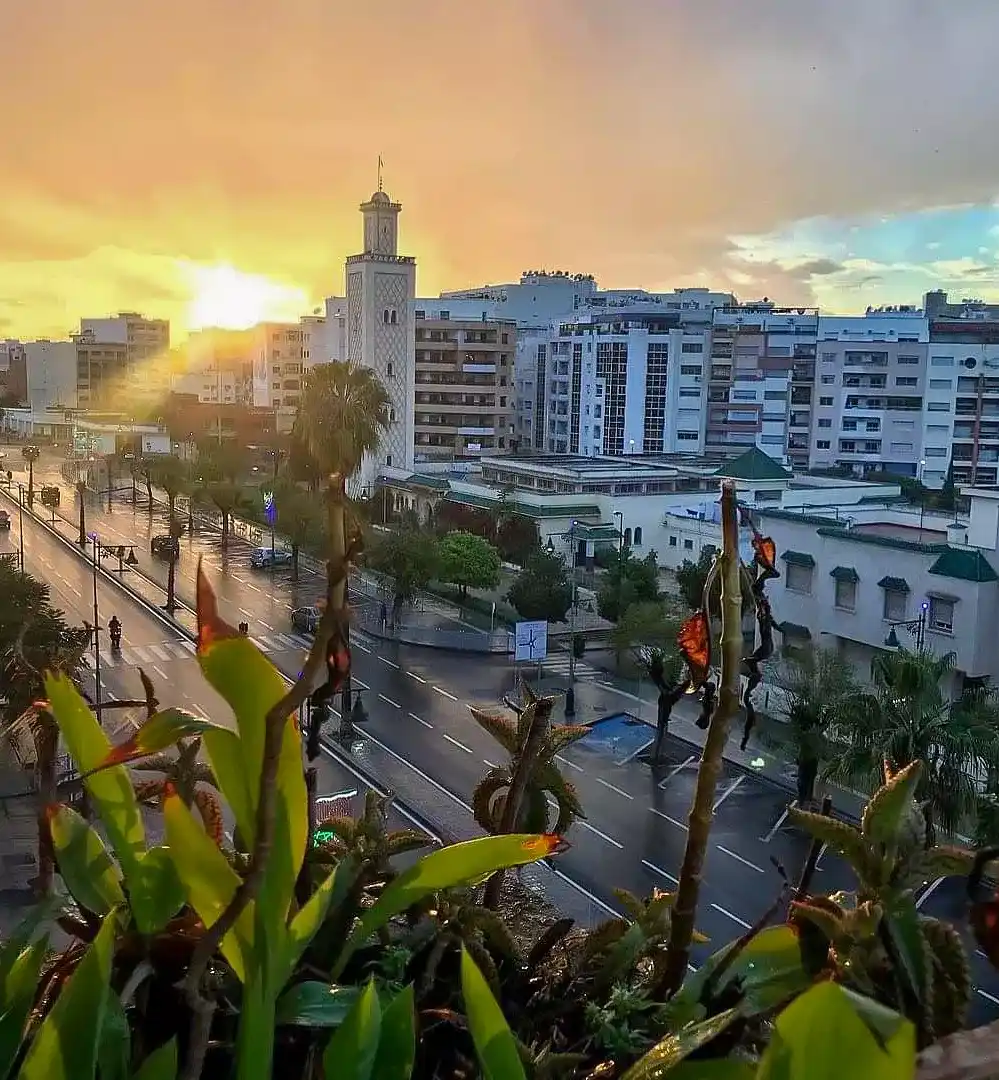
In 1672 the first of the sultans named Moulay Ismail made Meknes his imperial capital and built a great walled city and palaces that would equal those of the Palace of Versailles, France. A luxury tour will introduce you to this majestic architecture, exposing the monumental Bab Mansour Gate. This famous gate was constructed in the year 1732 and adorned with green-blue tiles and marble columns from the local antiquity.
The honest Meknes accommodation situation — and why it works in your favor
Meknes is the only Imperial City without an internationally branded 5-star hotel. There is no Four Seasons, no Ritz-Carlton, no Relais & Châteaux property currently operating in the city. For luxury travelers staying the night, the best options are Riad Yacout (cedar and zellij rooms, outdoor pool, hammam, closest quality property to Bab Mansour) and Riad Palais Didi (ancestral palace of a descendant of Sultan Moulay Sulaiman, five suites and seven rooms around a fountain courtyard — the most historically significant stay in Meknes).
However, Tilila Travel’s recommended approach is different — and most guests prefer it. Rather than overnighting in Meknes, we route guests through Meknes as a half-day visit on the transfer from Rabat to Fes, combined with a morning at Volubilis and a stop at Moulay Idriss Zerhoun. This gives you everything Meknes offers — Bab Mansour, the Royal Stables, the Mausoleum — in the time the city actually deserves (three to four hours), while placing you in Fes by early evening where the luxury riad selection is significantly stronger.
This is not a shortcut. It is the itinerary design that 90% of guests who have done both approaches prefer. We are transparent about it because your experience matters more than filling an extra hotel night.
The Volubilis visit most itineraries underserve: The UNESCO-listed Roman site 33 km from Meknes contains 30 in-situ mosaics that have survived largely intact since the 3rd century AD. The House of Orpheus, the House of the Labours of Hercules, the Triumphal Arch, the Capitoline Temple. Most group tours spend 45 minutes here.
A private tour gives it the 2 hours it needs. The difference between a rushed walkthrough and a proper Volubilis visit with a private historian who can explain the Roman-Berber fusion of the Volubilitan aristocracy is the difference between a checkbox and an experience.
The History of Chefchaouen: A Strategic Mountain Refuge
Chefchaouen was established by the Moroccan warrior, Chefchaouen Sherif Moulay Ali ibn Rashid al-Alami in the year 1471. This city has been created in the depths of the Rif Mountains as a military fort (Kasbah) to protect northern Morocco from the Portuguese attacks.
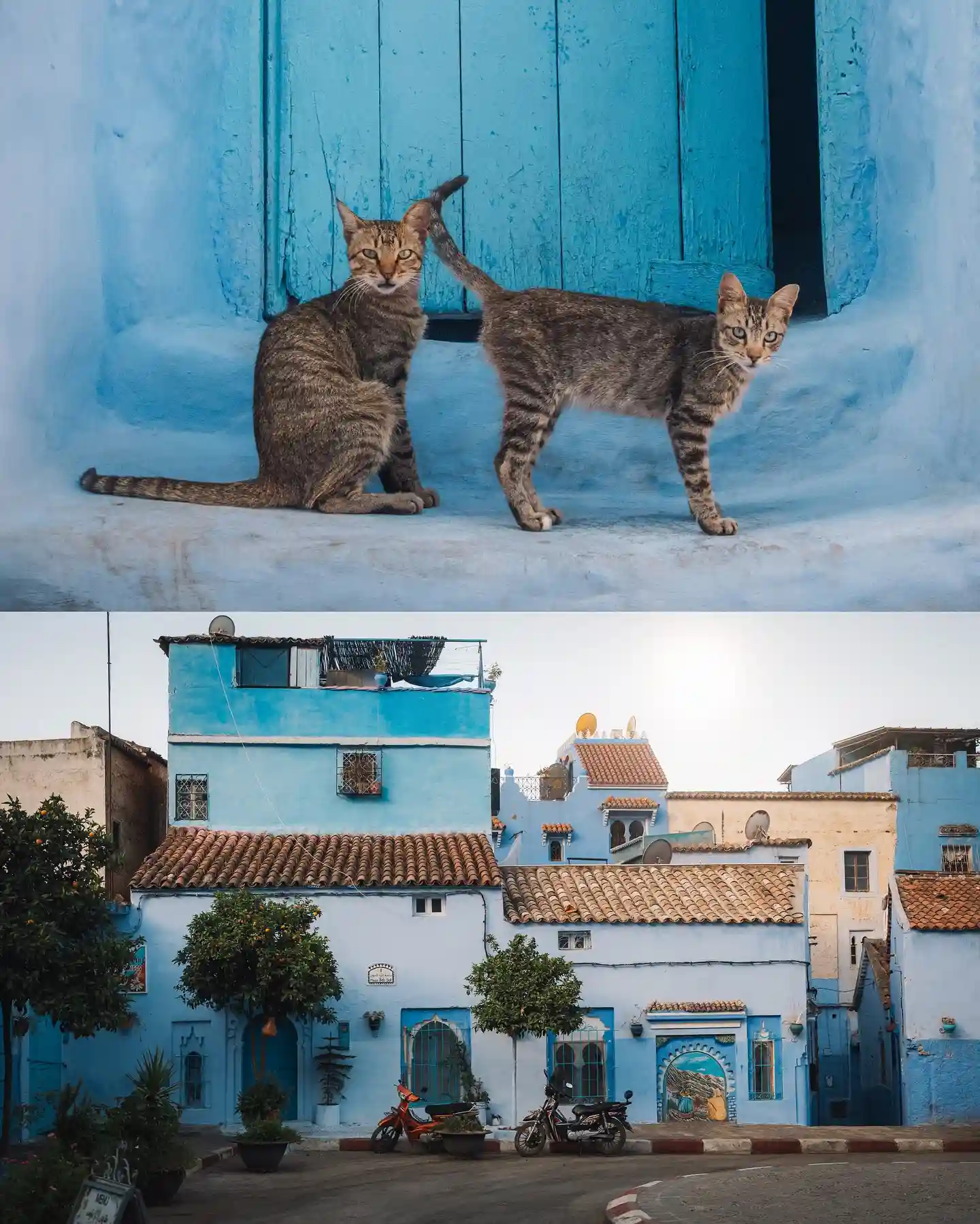
Following the conquest of Granada in 1492, it began to gradually serve as a home for thousands of expelled Muslim and Jewish inhabitants of the Spanish Inquisition. The tiled roofs and Andalusian style courtyards that are still present today are a direct influence of these exiles. Although the origin of its blue walls is not known, the tradition was continued by Jewish refugees in the 1930s. They painted the streets blue to symbolize the sky and heaven, a spiritual practice that transformed the medieval fortress into Morocco’s iconic “Blue Pearl”.
Where Tilila Travel guests stay in Chefchaouen
Chefchaouen sits at 600 metres elevation in the Rif Mountains — the evenings are cool year-round, even in summer, and the air quality is completely different from the medina cities below. The luxury riad options here are smaller and more intimate than Marrakech or Fes, which is precisely their appeal.
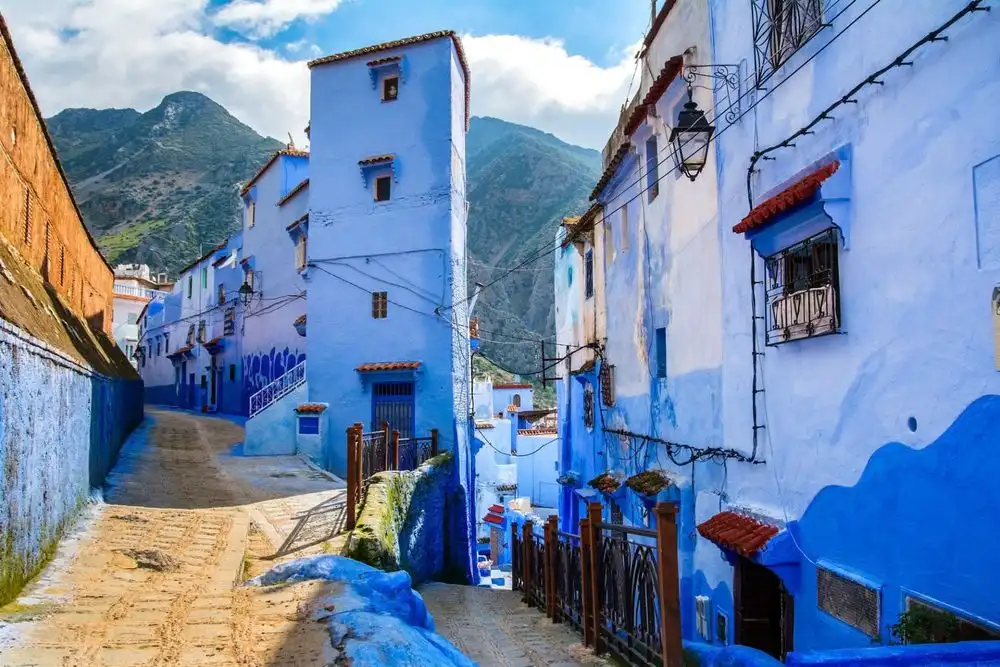
Lina Ryad & Spa is the standout property — 17 spacious suites arranged around traditional Moroccan courtyards, an indoor heated pool under a glass atrium, a full traditional hammam, and a rooftop terrace with unobstructed views over the Rif Mountains. The breakfasts here — served on the rooftop as the blue city comes to life below you at 8am — are among the most memorable meals on the entire Morocco route.
Dar Jasmine is the alternative for guests seeking the most intimate setting: a hillside boutique property with an infinity pool that looks directly over the blue medina, farm-to-table cuisine using ingredients from the property’s own garden, and a maximum of 12 guests at any time. The sense of privacy here — above the city, with the mountains behind and the blue rooftops below — is unlike anything available in Marrakech or Fes.
The photography guide your private tour provides: Chefchaouen’s walls are repainted twice a year, keeping the blue saturated and photogenic year-round. The five locations every serious photographer needs: the Spanish Mosque viewpoint (30-minute uphill hike from Bab el-Ain via the Ras El Maa spring — arrive 45 minutes before sunset when the entire blue city is bathed in golden light from the west), the Sidi Bouchouka staircase alley (the famous blue stairs — go before 8am to avoid the day-trippers from Fes and Marrakech), the Kasbah Museum towers for medina panorama, Plaza Uta el-Hammam at golden hour, and the white mosque of the souk for blue-versus-white contrast that most visitors walk past without stopping.
Your private guide’s practical advantage: the day-trippers who flood Chefchaouen between 10am and 4pm travel on fixed group schedules. Your private tour is structured around arriving at each location before they do and leaving after they have gone. The blue stairs at 7:30am with nobody in the frame. The Spanish Mosque at sunset with the path to yourself. This is not luck — it is the itinerary design.
A Complete 8-Day Imperial Cities Private Itinerary
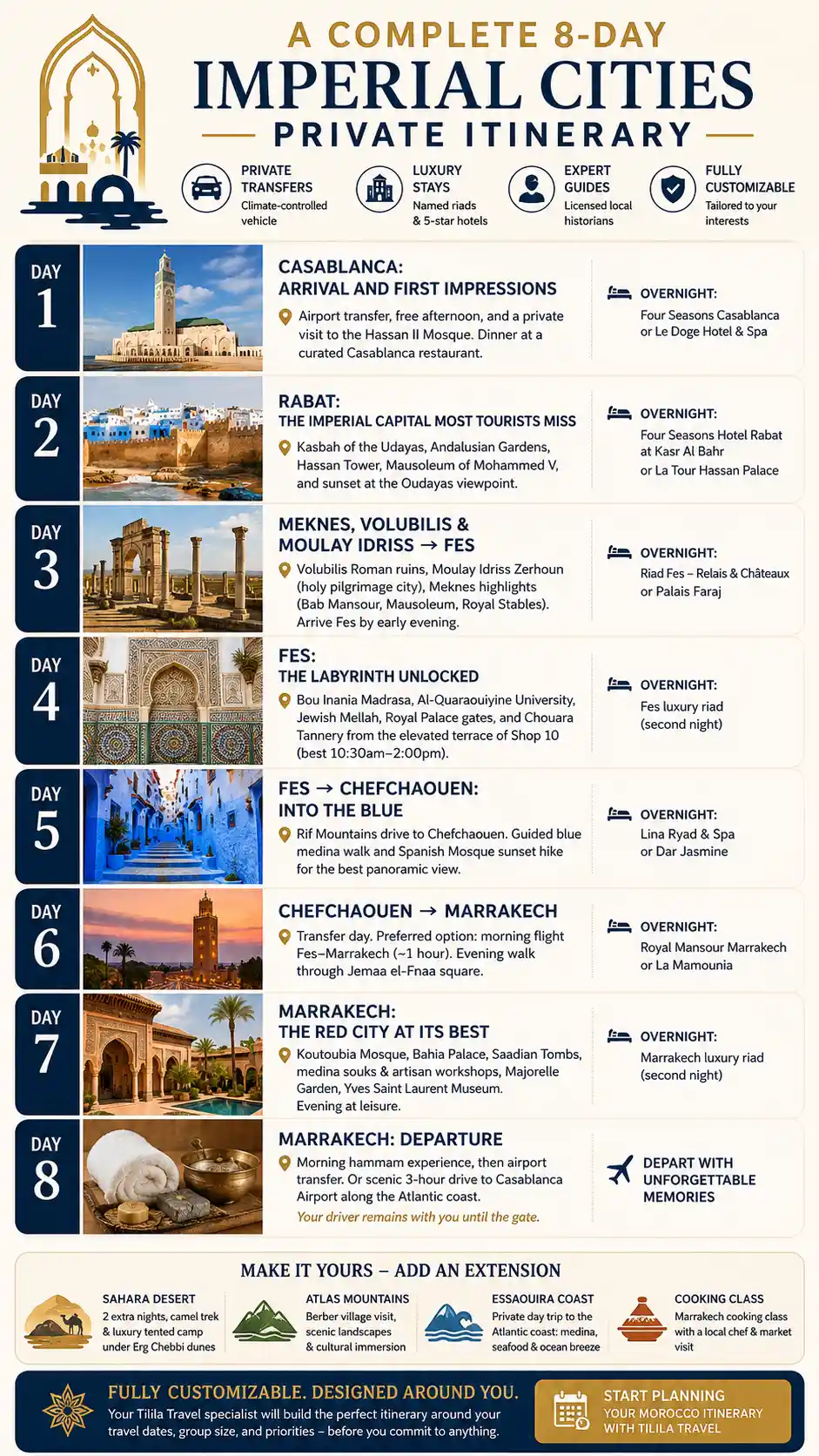
No two Tilila Travel tours are identical — but if you are visiting Morocco’s Imperial Cities and Chefchaouen for the first time, this 8-day private route is the one our guests consistently describe as the most complete and rewarding way to experience the country. Every transfer is in a private climate-controlled vehicle. Every overnight is a named luxury riad or 5-star hotel. Every city arrives with a licensed local historian waiting.
Day 1 — Casablanca: Arrival and First Impressions
Your Tilila Travel driver meets you at Mohammed V International Airport and transfers you directly to your hotel. The afternoon is free to settle in. In the early evening, a private guided visit to the Hassan II Mosque — the only mosque in Morocco open to non-Muslim visitors, built on a platform over the Atlantic Ocean, with a retractable roof and laser beam pointing toward Mecca — gives you an immediate sense of the scale Morocco operates at. Dinner at a curated Casablanca restaurant rounds off the first evening.
Overnight: Four Seasons Casablanca or Le Doge Hotel & Spa
Day 2 — Rabat: The Imperial Capital Most Tourists Miss
One hour north along the Atlantic coast lies Rabat — Morocco’s quietest and most underrated Imperial City. Your private historian leads you through the Kasbah of the Udayas (a 12th-century fortress where blue-and-white painted alleys meet the Atlantic), the Andalusian Gardens, the iconic Hassan Tower (the unfinished minaret abandoned in 1199), and the Mausoleum of Mohammed V with its intricate white marble and carved cedar interior. Unlike Marrakech and Fes, Rabat has almost no tourist crowds — you will explore at your own pace without being rushed.
At sunset, walk to the Oudayas viewpoint where the Bouregreg River meets the ocean. It is one of the most quietly beautiful moments on the entire route.
Overnight: Four Seasons Hotel Rabat at Kasr Al Bahr (Atlantic shore, rooftop infinity pool) or La Tour Hassan Palace (iconic 1912 Moorish-Andalusian property, walking distance to Hassan Tower)
Day 3 — Meknes, Volubilis & Moulay Idriss → Fes
This is the most historically dense single day of the tour. Departing Rabat, your first stop is Volubilis — a UNESCO World Heritage Roman site 33 km north of Meknes, containing 30+ in-situ mosaics including the House of Orpheus, the Capitoline Temple, and a triumphal arch standing largely intact since 217 AD. Most visitors spend 90 minutes here; your private guide gives it the two hours it deserves.
From Volubilis, a short drive brings you to Moulay Idriss Zerhoun — Morocco’s holiest pilgrimage city, founded in 788 AD, built around the tomb of the Prophet Muhammad’s great-great-grandson. Few itineraries include it. It is worth every minute.
Then into Meknes itself: the monumental Bab Mansour Gate (completed 1732, green-blue tilework and marble columns looted from the Roman ruins at Volubilis), the Moulay Ismail Mausoleum, and the vast Royal Stables and Heri es-Souani granaries engineered to feed 12,000 horses. The ambition of Meknes on a private tour — with no group schedule to keep — finally becomes legible.
Arrive Fes by early evening.
Overnight: Riad Fes — Relais & Châteaux (the only R&C-branded riad in Fes; rooftop pool overlooking the medina and Atlas Mountains) or Palais Faraj (19th-century palace, 25 individually designed suites, infinity pool, Givenchy-inspired spa)
Day 4 — Fes: The Labyrinth Unlocked
Fes el-Bali — a UNESCO-listed medina of over 9,000 streets — is the city that breaks group tours and rewards private ones. Your morning begins at Bou Inania Madrasa (the finest example of Marinid Islamic architecture in Morocco, built 1351, with carved cedarwood, zellij tilework, and a water clock visible from the street). From there, a private historian guides you to Al-Quaraouiyine — the oldest continuously operating university in the world, founded 859 AD — and through the Jewish Mellah to the gold-worked gates of the Royal Palace.
The afternoon is reserved for Chouara Tannery — and Tilila Travel’s approach here is the one thing that separates an extraordinary visit from a frustrating one. Rather than routing guests through the street-level leather shops (where “free guides” earn commission on every purchase), your historian takes you directly to the elevated terrace of Shop 10 — the single best aerial view of the dyeing pits in full operation. The best time to visit is between 10:30am and 2:00pm, when the vat colors are at their richest and workers are most active. A sprig of mint is offered at the entrance. Take it.
Overnight: Fes luxury riad (second night)
Day 5 — Fes → Chefchaouen: Into the Blue
Four hours northwest through the Rif Mountains brings you to Chefchaouen — Morocco’s Blue Pearl, founded in 1471 at 600 metres elevation as a mountain fortress against Portuguese invasion, later transformed by Jewish and Muslim exiles from Andalusia whose influence is still visible in every tiled roof and courtyard. Your private guide walks you through the blue medina in the late afternoon when the light turns golden against the painted walls.
The day’s signature moment: the Spanish Mosque sunset hike. From Bab el-Ain, a 30-minute trail through the Ras El Maa spring area leads to the abandoned 1920s mosque on the hill above the city. Arriving 45 minutes before sunset, the entire blue medina spreads below you in the last light. It is the single most-photographed view in Morocco. On a private tour, you arrive before the crowds and leave after them.
Overnight: Lina Ryad & Spa (17 suites, indoor heated pool under glass atrium, full hammam, rooftop Rif Mountain views) or Dar Jasmine (hillside boutique, infinity pool overlooking the blue medina)
Day 6 — Chefchaouen → Marrakech
The longest transfer day of the route, managed entirely by your private driver. The preferred option for many guests is a morning flight from Fes-Saïs Airport to Marrakech Menara (approximately 1 hour), freeing the afternoon for a relaxed Marrakech arrival, riad check-in, and an evening walk through the Jemaa el-Fnaa — the central square that transforms from a market into an open-air theatre after sunset, with food stalls, musicians, storytellers, and snake charmers operating simultaneously in a scene unchanged for centuries.
Overnight: Royal Mansour Marrakech (53 private riads each with rooftop plunge pool and dedicated butler; ranked 13th in The World’s 50 Best Hotels 2025) or La Mamounia (voted #1 Hotel in Africa in the 2024 Condé Nast Traveler Readers’ Choice Awards)
Day 7 — Marrakech: The Red City at its Best
A full day in Marrakech structured for depth rather than coverage. Morning: Koutoubia Mosque (the 12th-century landmark whose minaret became the architectural template for the Giralda in Seville and the Hassan Tower in Rabat), Bahia Palace (19th-century grand vizier’s residence, 8 hectares of ornate rooms and Andalusian gardens), and the hidden Saadian Tombs (sealed for 200 years, rediscovered in 1917, containing 66 royal graves decorated with Italian Carrara marble and gold-leaf cedar).
Afternoon: the winding souks of the medina with your private guide, where Tilila Travel’s local relationships mean genuine access to artisan workshops — not tourist-facing shops — and prices that reflect what locals actually pay. Late afternoon: Majorelle Garden before the 5pm crowds, followed by the adjacent Yves Saint Laurent Museum.
Evening at leisure — your Tilila Travel guide recommends the best rooftop for sunset Koutoubia views, then dinner at a restaurant chosen for the table, not the tourist rating.
Overnight: Marrakech luxury riad (second night)
Day 8 — Marrakech: Departure
A final morning hammam at your riad’s spa — the traditional Moroccan ritual of black soap, kessa exfoliation, and rhassoul clay that every traveler should experience at least once — before your driver transfers you to Marrakech Menara Airport, or for guests flying from Casablanca, a scenic three-hour drive back along the Atlantic coast.
Your Tilila Travel driver remains with you until the departure gate.
This itinerary is fully customizable. Add a Sahara desert extension from Marrakech (2 extra nights, camel trek, luxury tented camp under Erg Chebbi dunes), an Atlas Mountain and Berber village day, a private Essaouira coastal excursion, or a Marrakech cooking class with a local chef.
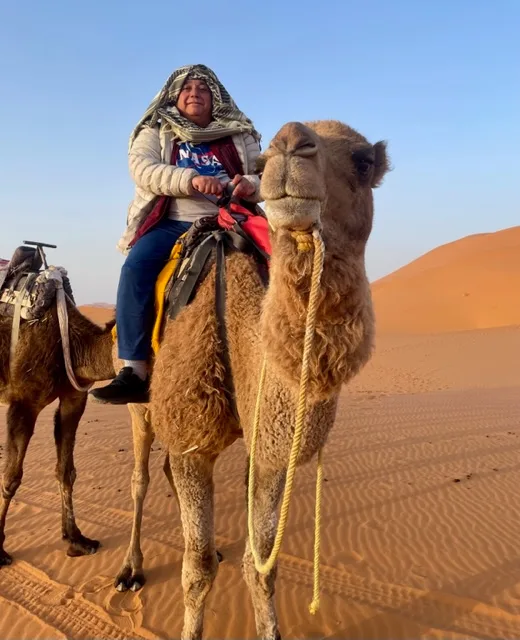
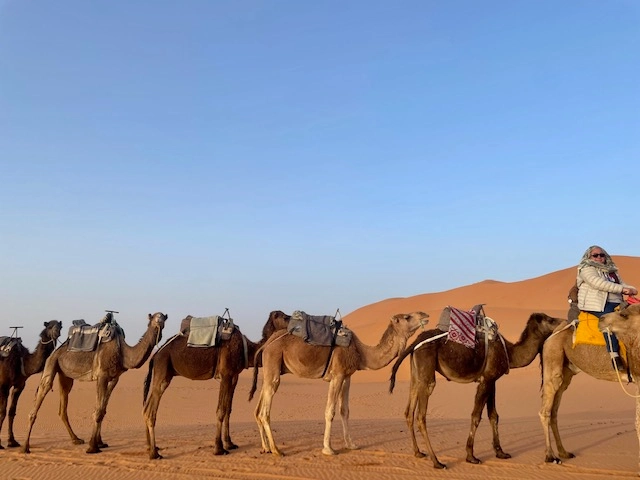
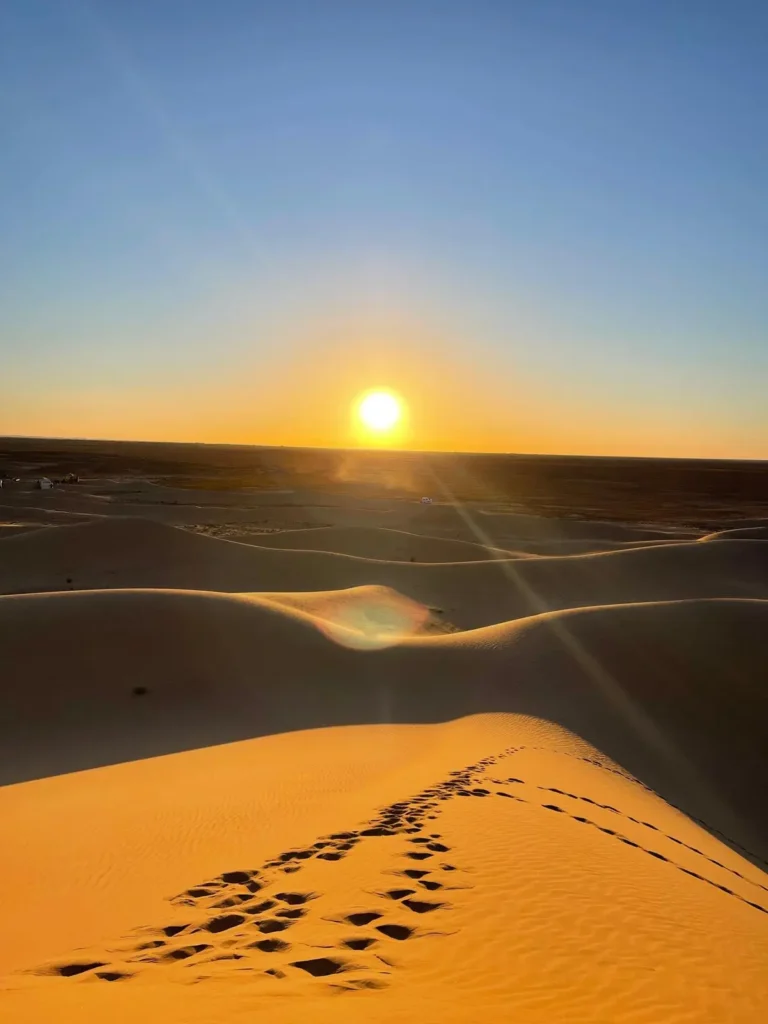
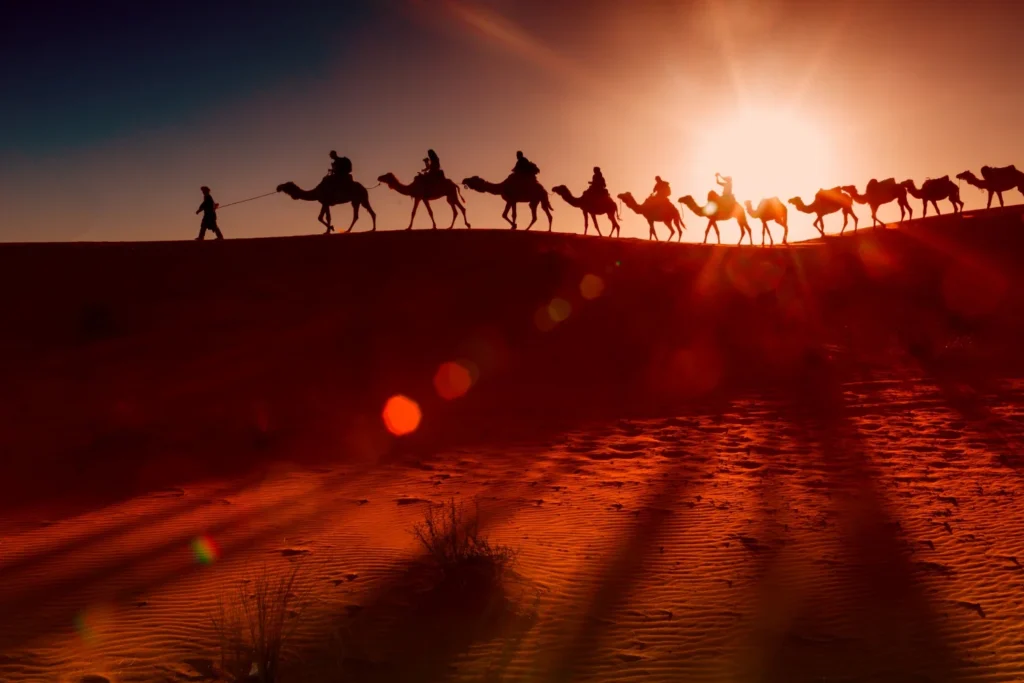
Your Tilila Travel specialist will build the final itinerary around your exact travel dates, group size, and priorities — before you commit to anything.
→ Start planning your private Morocco itinerary with Tilila Travel
Why a Private Luxury Tour is Your Only Real Choice in Morocco
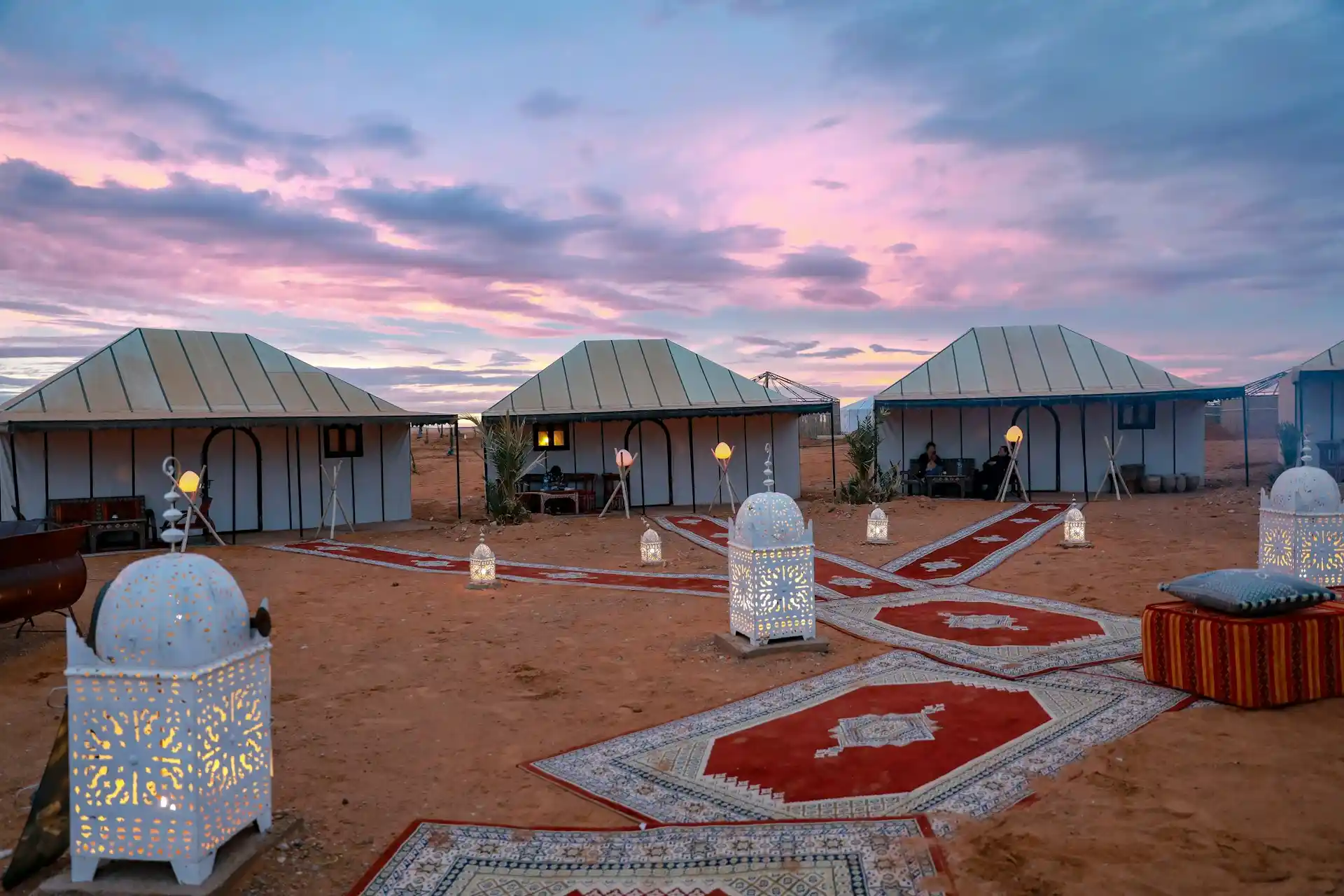
Morocco is a beautifully overwhelming country, but there is a massive difference between surviving its chaos and mastering its magic. Anybody can reserve a 5-star hotel room by using a credit card. But, luxury private tours Morocco are an investment in taking control of your time, maximum peace of mind and access to moments that aren’t online.
You’ll use half the effort when you’re on your own to deal with stress:
- Negotiating with pushy sellers in the market
- Finding yourself lost in narrow alleys
- Driving through hazardous mountain roads
No matter if it’s a group tour or you’re traveling solo, or whatever your mode of transport is, a private luxury tour will eliminate all these barriers, in exchange for curated, exclusive experiences.
| Feature | Private Luxury Tour | Standard Group Tour |
| Schedule Flexibility | Fully customized to your interests and pace | Fixed itinerary with limited flexibility |
| Personalized Experience | Tailored activities, accommodations, and dining | Same experience for all travelers |
| Transportation | Private chauffeur and luxury vehicle | Shared bus or van transportation |
| Access to Hidden Gems | Opportunity to explore off-the-beaten-path locations | Focus on major tourist attractions |
| Comfort Level | Premium accommodations and exclusive services | Varies depending on tour package |
| Cultural Immersion | More time for authentic local experiences | Limited interaction due to tight schedules |
| Privacy | Travel exclusively with your chosen companions | Travel with large groups of strangers |
| Photography Opportunities | Stop whenever you want for photos | Limited stops and strict timing |
| Dining Experiences | Choice of high-end restaurants and local favorites | Pre-selected group meals |
| Overall Experience | Exclusive, stress-free, and highly personalized | More structured and less individualized |
Everything You Need to Know Before Your Private Morocco Tour
The questions that appear in every first inquiry to Tilila Travel — visa requirements, which airport to fly into, how much to tip, what to wear — answered directly and honestly so you can plan without uncertainty.
Do I Need a Visa for Morocco?
Citizens of the United States, United Kingdom, European Union, Canada, Australia, and New Zealand do not require a visa to enter Morocco. You may stay up to 90 days. Your passport must be valid for at least 6 months beyond your entry date. No eVisa, no advance application, no embassy appointment — you present your passport at immigration and enter.
If you hold a passport from a country not on the visa-free list, Morocco introduced an eVisa system in 2022 that allows online applications for qualifying nationalities. Tilila Travel can advise on your specific passport situation as part of the pre-trip planning process.
Which Airport Should I Fly Into?
Casablanca Mohammed V International (CMN) is the primary international gateway — the most direct flights from North America, Europe, and the Gulf land here, and it is the logical starting point for the Imperial Cities route (Casablanca → Rabat → Meknes → Fes → Chefchaouen → Marrakech).
Marrakech Menara (RAK) works as an arrival airport for guests starting their itinerary in the south, or as a departure airport for guests ending in Marrakech — the option most Tilila Travel guests choose.
The most efficient routing for an 8-day Imperial Cities tour is an open-jaw itinerary: fly into Casablanca, depart from Marrakech. This eliminates the need to backtrack and gives you a clean linear route through all five cities without retracing a single road.
Getting Between the Imperial Cities
All transfers on a Tilila Travel private tour are in a climate-controlled Mercedes or equivalent private vehicle with your dedicated driver. This is not a logistical compromise — it is where much of the trip’s value is created. The road from Fes to Chefchaouen winds through the Rif Mountains for four hours of scenery that no train route covers.
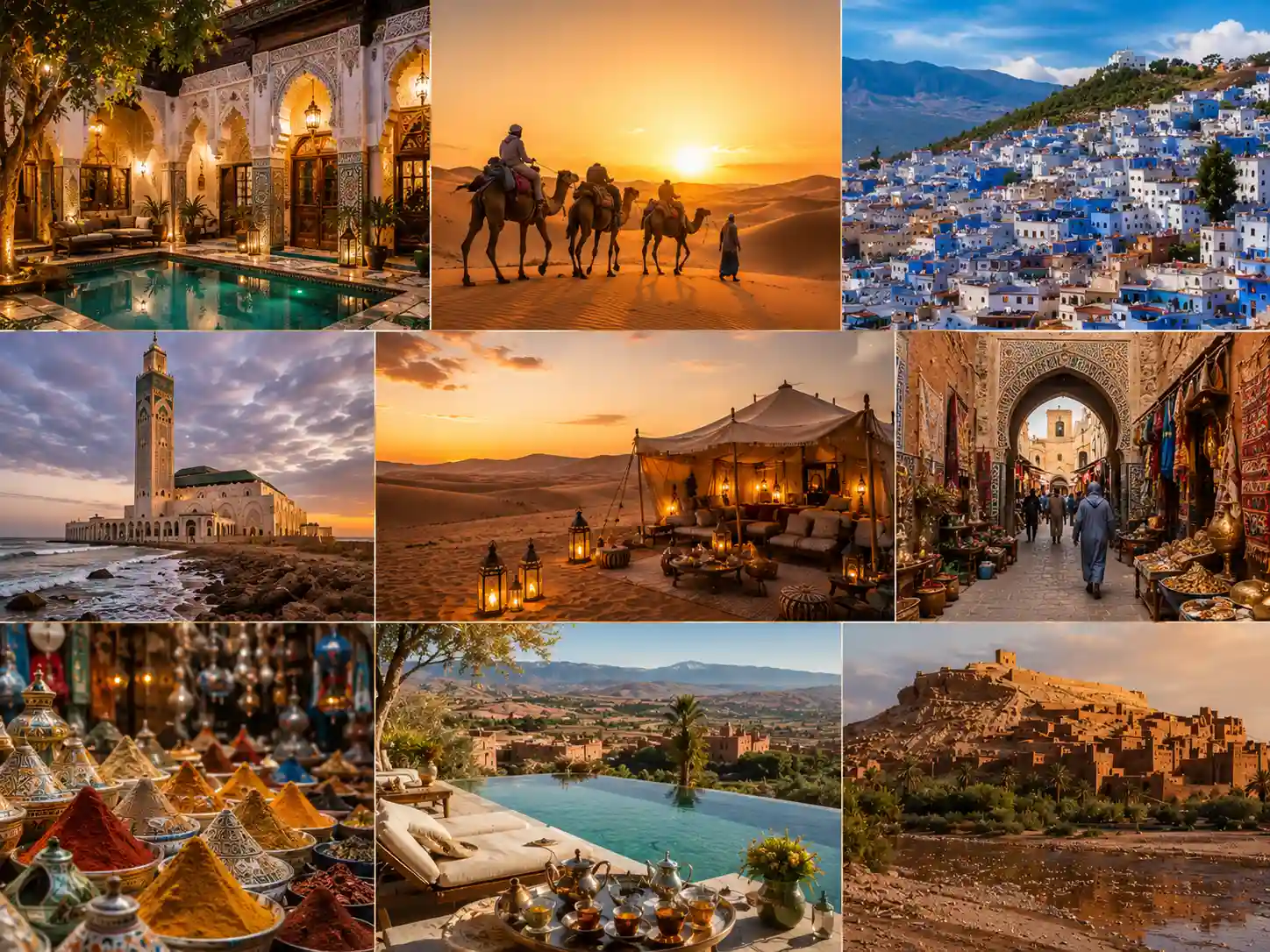
The stop at Volubilis on the Rabat-to-Fes transfer only happens if you are in a private vehicle. The Berber village detour through the Middle Atlas, the panoramic roadside stop above Meknes, the olive grove lunch break — none of these exist on a fixed schedule.
Morocco does have the Al Boraq high-speed train — Africa’s first, running at 320 km/h, connecting Casablanca to Tangier via Rabat in approximately 2 hours 10 minutes. For the Casablanca-to-Rabat leg specifically, some guests prefer the train experience.
Your Tilila Travel driver will collect you at Rabat station and continue the journey by road from there. For all other city connections on the Imperial Cities route, private road transfer remains the superior option.
The Complete Tipping Guide for Morocco
Tipping in Morocco is expected and meaningful — guides and drivers are paid a base rate that assumes gratuities from satisfied guests. The amounts are modest by Western standards and make a genuine difference to the people who make your trip work.
| Service | Recommended Tip (MAD) | USD Equivalent |
|---|---|---|
| Private driver (per day) | 200–300 MAD | $20–30 |
| Private full-day guide | 200–300 MAD | $20–30 |
| Private half-day guide | 100–150 MAD | $10–15 |
| Riad porter (per bag) | 20–30 MAD | $2–3 |
| Riad housekeeping (end of stay) | 50–100 MAD per night | $5–10 per night |
| Restaurant (good service) | 10–15% of bill | — |
| Hammam attendant (full ritual) | 150–200 MAD | $15–20 |
| Tannery terrace (if no leather purchase) | 20–50 MAD per person | $2–5 |
| Taxi (round up) | 5–10 MAD | $0.50–1 |
Practical note: Always tip in Moroccan Dirham, not foreign currency. Always use your right hand — tipping left-handed is considered impolite. A simple shukran (thank you in Darija Arabic) alongside the tip is appreciated and noticed.
On a Tilila Travel private tour, your driver and guide are the two most important relationships of the entire trip. They are also the people who will tell you the restaurant that is not in any guidebook, the viewpoint that no other tourists visit, and the right price for the leather jacket your guide says is worth half what the vendor is asking. Tipping well at the end of the trip is both the right thing to do and the signal that the relationship worked as it should.
What to Wear in the Medinas
Morocco’s medinas are active religious and residential neighborhoods, not tourist attractions — and dressing appropriately is both a matter of respect and a practical benefit. Guides consistently report that guests who dress modestly receive warmer welcomes, fewer unsolicited approaches, and better prices in the souks.
The practical rule: Shoulders and knees covered. Loose, breathable fabric in natural fibers (linen or cotton) works best for medina walks in warm weather. Closed-toe shoes with grip — medina cobblestones are uneven, often wet, and occasionally slick with water from the tanneries. Sandals cause problems.
City by city:
Fes is the most conservative of the Imperial Cities. Dress more covered here than anywhere else on the route — this is a working religious city where the medina is not oriented toward tourism. Women should carry a light scarf for entering mosque courtyards and religious sites. Men should avoid shorts in the medina.
Marrakech (specifically the Gueliz and Hivernage districts outside the medina) is significantly more relaxed — the dress code loosens once you leave the medina walls. Inside the medina and around the Jemaa el-Fnaa, the same conservative standard applies.
Chefchaouen — the mountain elevation makes evenings cool year-round. A light layer or cardigan is essential even in summer. The medina is relaxed compared to Fes; the atmosphere is genuinely welcoming and less overwhelming.
Rabat is the most relaxed of the Imperial Cities in terms of dress — Morocco’s capital is a cosmopolitan city where Western professional dress is common. The Kasbah of the Udayas and Hassan Tower area requires the same modesty as any medina site, but the city overall is the easiest for those unaccustomed to adjusting dress for different contexts.
One item to always pack: A lightweight scarf (women). It serves triple duty — mosque visits, cool Chefchaouen evenings, and the occasional moment of midday shade on the Volubilis site where there is no natural cover. It takes up no space and solves three problems.
Currency, Cash, and Payments
Morocco’s currency is the Moroccan Dirham (MAD). The approximate exchange rate as of 2026: 10 MAD = $1 USD and 11 MAD = €1 — making mental arithmetic straightforward.
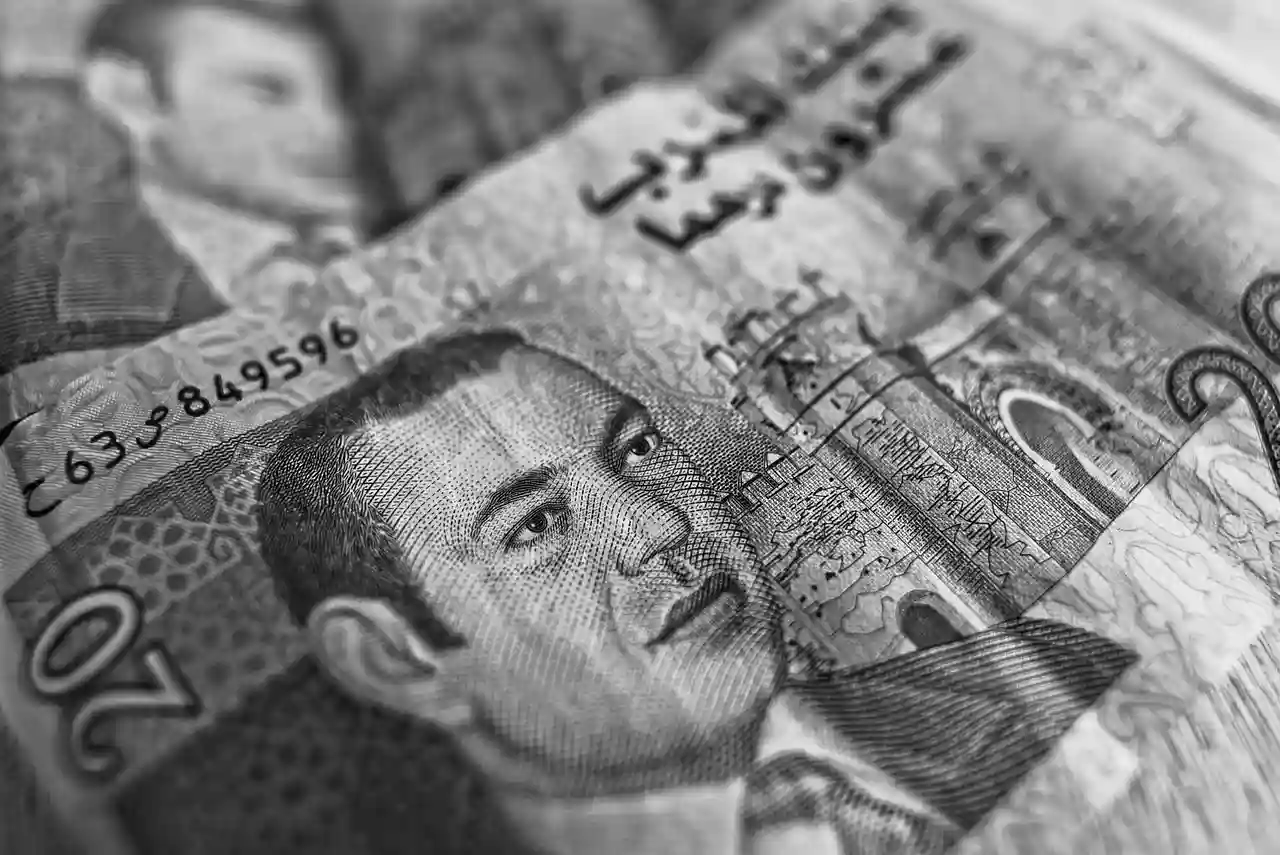
Critical practical note: The Dirham is a closed currency, meaning you cannot obtain MAD outside Morocco. Do not attempt to source it before travel. Instead, withdraw from an ATM at Casablanca Mohammed V Airport on arrival — the machines are well-stocked, the rates are reasonable, and you will want local cash for the first day before your riad can assist.
What to request: 100 and 200 MAD notes are standard. Ask the airport bank counter (not the ATM) for a supply of 10 and 20 MAD notes for tipping — larger notes cause change problems in the medina.
What accepts cards: All Tilila Travel luxury riads, 5-star hotels, and high-end restaurants accept major credit cards. Most souk vendors and medina shops are cash-only. Market purchases, tannery tips, small café stops, and any transaction outside the formal hotel and restaurant sector require MAD cash.
What Tilila Travel handles: All accommodation payments, guide fees, and included meal costs are managed through the tour pricing — you will rarely need to handle payment logistics on the ground. Your daily cash requirement for tips, souvenirs, and personal spending is typically 200–500 MAD per day depending on your shopping habits.
Is Morocco Safe for Luxury Travelers?
Yes — and private touring eliminates the specific situations where problems occur.
The U.S. State Department rates Morocco as Level 1 (Exercise Normal Precautions) — the same rating as France, Germany, and Japan. The Imperial Cities are safe for visitors. The practical risks in Morocco are the ones common to any crowded urban environment: pickpocketing in dense crowds, commission-based “free guides” who attach themselves to tourists in the medina, and aggressive souk vendors. None of these apply on a private tour.
You are never in a crowd without a guide, never navigating the medina independently, and never negotiating without someone who knows exactly what things cost.
Tilila Travel guests are in a private vehicle between cities, in a named luxury property every night, and with a licensed guide during every medina visit. The experience of Morocco’s complexity — which is genuine and which is part of what makes it extraordinary — is managed so you encounter the richness without the friction.
What Makes Luxury Private Tours Morocco Special?
The luxury private tours are designed for those seeking a personalized traveling experience Therefore, each detail of the trip can be organized according to your wishes, such as hotel, transportation, activities, restaurants, sightseeing, and rhythm of travel etc.
Tilila Travels focus on quality rather than quality. Instead of rushing from one city or place to another, they allow you enough time to enjoy each city, landscape, and culture experience. So, your Morocco vacation is relaxed, more personal and more memorable.
Here’s what the luxury Morocco private tours can include:
- Private, air conditioned transport with professional driver
- Local guides in Morocco’s historic cities
- Luxury riads, boutique hotels, desert camps and 5-star hotels are highly selected.
- Tailor your trip with personalised itineraries for your interests and dates.
- Flexible time, allowing for time to rest and enjoy each destination.
- Improved service to the high profile cultural and visitor sites in a VIP manner
- Camel riding, luxury desert camping & private desert tour.
- Savor yourself in Moroccan food and enjoy a wonderful Moroccan dinner.
- The course is a family-friendly adventure that allows everyone to enjoy the magical experience of Morocco.
Crafting Your Custom Itinerary: What a Premium Tour Includes
Tilila Travel understands the traveling preferences of individual travelers. Hence, there’s no doubt about the flexibility of Luxury Private Tours in Morocco. You can arrange everything, from history to architecture, photography, food, shopping, desert adventure, nature, relaxation in a private tour that suits your needs.
Alternatively, you can choose from one of the short luxury city breaks, a private tour to the desert from Marrakech, a cultural tour to the imperial cities of Morocco or a fully arranged luxury Morocco tour to the most beautiful places. The expert crew members prepare everything that you need to relax and enjoy!
In addition, all tours are well planned and focus on providing an inclusive traveling experience that you won’t find on a group tour or during solo travel. Some of the most popular luxury private tour experiences in Morocco include:
- Night time private tours of Marrakech with luxury riad accommodation.
- Sahara desert tours from Marrakech or Fes are luxury tours in the Sahara desert.
- Private Morocco tours specially for couples and honeymooners
- Super Luxury Morocco holidays for the family.
- For more information on private tours tailored for seniors, please contact us today.
- The trip to the Imperial cities of Marrakech, Fes, Rabat and Meknes.
- Private Tours in Morocco to Chefchaouen, Blue Morocco City.
- Atlas Mountains and Berber village experiences
- The luxury Morocco vacations come with a private driver and guide for you.
Final Words
That’s all you need to know about the luxury private tours in Morocco. Book your private excursion Morocco, trips and vacations with Tilila Travel. Private Tours throughout Morocco are organized in all directions including Marrakech, Fes, Rabat, Chefchaouen, Sahara desert, and many other beautiful places.
Taste the Moroccan cuisine, the architecture, the colourful markets, the desert, ride a camel, enjoy the luxurious accommodation and the warm hospitality.
Frequently Asked Questions
How much does a luxury private Morocco tour cost?
Luxury private Morocco tours with Tilila Travel range from $250 to $450 per person per day depending on accommodation tier, group size, and travel dates. A couple on an 8-day Imperial Cities itinerary staying in named luxury riads typically pays $3,200 to $4,200 per person including private transport, licensed guides, accommodation, and most meals. Contact Tilila Travel for an exact quote built around your specific itinerary and dates.
How many days are enough to explore the Imperial Cities and Chefchaouen?
Eight to ten days is the recommended minimum for a complete Imperial Cities and Chefchaouen private tour covering Casablanca, Rabat, Meknes, Volubilis, Fes, Chefchaouen, and Marrakech. Seven days is achievable but requires faster pacing through Fes and Rabat, which most guests find unsatisfying. Ten days allows for a Sahara desert extension or Atlas Mountain day without feeling rushed at any point on the route.
What is the best time to do a private tour of Morocco?
Spring (March–May) and autumn (September–November) are the two peak windows for a private Morocco tour, with October widely considered the single best month. Temperatures across all Imperial Cities are comfortable — typically 18°C to 28°C — crowds are thinner than summer, and the light for photography is exceptional. Avoid July and August when Marrakech and Fes regularly reach 40°C and medina walks become genuinely uncomfortable.
Why is Chefchaouen painted blue?
The most widely accepted explanation credits Jewish refugees who settled in Chefchaouen in the 1930s, painting the walls blue as a spiritual practice — in Jewish tradition, blue represents the sky, the divine, and closeness to God. A secondary explanation holds that copper-sulphate-tinted blue paint genuinely repels mosquitoes, giving the tradition both spiritual and practical roots. Today the walls are repainted twice a year, keeping the color saturated and the Blue Pearl identity intact.
Why choose a private tour instead of a group tour in Morocco?
A private tour eliminates every situation where group tours break down in Morocco — the medina navigation, the tannery commission shops, the fixed schedule that leaves Volubilis in 45 minutes. With Tilila Travel, your vehicle, driver, guide, and daily schedule belong entirely to you and your travel companions. You move at your own pace, stop where you want, and access moments — the tannery at 10:30am from the exclusive terrace, Chefchaouen’s blue stairs at 7:30am before any other tourists — that group schedules cannot reach.
Does Chefchaouen belong in an Imperial Cities tour?
Chefchaouen is not one of Morocco’s four official Imperial Cities, but it is included in nearly every Imperial Cities itinerary as the journey’s most visually distinctive stop — and for good reason. The blue medina, the Spanish Mosque sunset viewpoint, and the Rif Mountain atmosphere offer a complete tonal contrast to the intense historical weight of Fes and Marrakech. On a private tour structured around early morning arrivals before the day-trippers, Chefchaouen fully justifies the detour.
How do I visit the Chouara Tannery in Fes without being scammed?
The key is access point — most tourists are routed through street-level leather shops by commission-based “free guides” who require you to walk through the shop before reaching any viewing terrace. Tilila Travel takes guests directly to the elevated terrace of Shop 10, which provides an unobstructed aerial view of the full tannery in operation with no purchase requirement. Visit between 10:30am and 2:00pm for the most active dyeing work and the most vivid pit colors.
What currency does Morocco use and how much cash do I need daily?
Morocco uses the Moroccan Dirham (MAD) — approximately 10 MAD to $1 USD. The Dirham is a closed currency that cannot be obtained outside Morocco, so withdraw from the ATM at Casablanca airport on arrival. On a Tilila Travel private tour, accommodation and guide fees are handled through the tour pricing, so your daily cash requirement is typically 200–400 MAD for personal tips, small souk purchases, and incidentals.
Can Tilila Travel change my itinerary mid-trip if I want to?
Yes — flexibility is the central advantage of a private tour and Tilila Travel designs explicitly for it. If you want more time in Fes, a different restaurant than planned, an extra morning in Chefchaouen before driving south, your driver and guide adapt. Mid-trip adjustments are handled directly through WhatsApp with your Tilila Travel contact who remains reachable throughout your entire journey. The itinerary is a framework, not a contract.
What is the best time to do a private tour of Morocco?
The best weather for visiting is in the spring (March-May) or autumn (September-November) season. The ideal times to visit medinas, monuments and mountain towns such as Chefchaouen are these.