Manuel Antonio National Park by car, from the SINAC ticket to the last parking tout

Just past the El Avión bar on Route 618, a guy in a khaki shirt walks into the road and flags you toward a gravel lot. He looks official enough. He’s no ranger, though, and that lot means a long, sweaty walk to the gate of Manuel Antonio National Park.
The 3 hours of driving from San José rarely cause trouble. That roadside wave catches far more people. The park is compact and easy on foot, but the logistics around it aren’t, with online tickets that sell out, a weekly closing day that changed, a food ban rangers take seriously and a stretch of road where half the uniforms are costumes.
This guide covers the whole visit in order: buying tickets, the drive, parking, the trail map, guides, and the best spots for photos.
Where is Manuel Antonio National Park?
Manuel Antonio National Park (Parque Nacional Manuel Antonio) sits on Costa Rica’s central Pacific coast in Puntarenas province, about 7 km south of the town of Quepos. It’s one of the smallest national parks in the country by land area, but it’s also one of the most visited. Rainforest runs right down to white-sand beaches. (SINAC)
The park was created in 1972 and also protects a large marine area offshore, including a string of small islands. For planning, think of it this way: Quepos is the town with banks, supermarkets and the small airstrip, Manuel Antonio village is the hotel strip on the hill, and the park entrance is at the bottom of that hill, near Playa Espadilla.
Tickets are online only, and they go fast
The gate doesn’t sell tickets anymore. You buy Manuel Antonio National Park tickets online on the SINAC website (SINAC runs the national parks), and it makes you create an account before anything else. That’s why the night before is a bad time to start.
Every visitor’s passport number gets printed on the ticket. At the entrance, the ranger compares it with your ID, so bring the actual passport for everyone in the car.
How much is the Manuel Antonio entrance fee?
Non-resident adults pay about $18 with tax, on a base fee of $16. Kids aged 2 to 12 come in around $5.65, though SINAC tweaks prices, so trust whatever it shows when you book. Costa Rican residents and nationals pay a much lower colón rate with valid ID.
Why the rush? The park releases only about 3,000 tickets a day. From late December to February that cap gets hit, and since booking opens roughly two months ahead, high season visitors should buy as soon as their dates are firm.
And you choose an entry slot. The earliest runs 7:00 to 7:40 am and the latest 1:00 to 2:30 pm. I’d take the early one every time, because the late slot gives you maybe 90 minutes before the beaches inside close at 3 pm, and by then the heat has sent most of the animals into hiding.
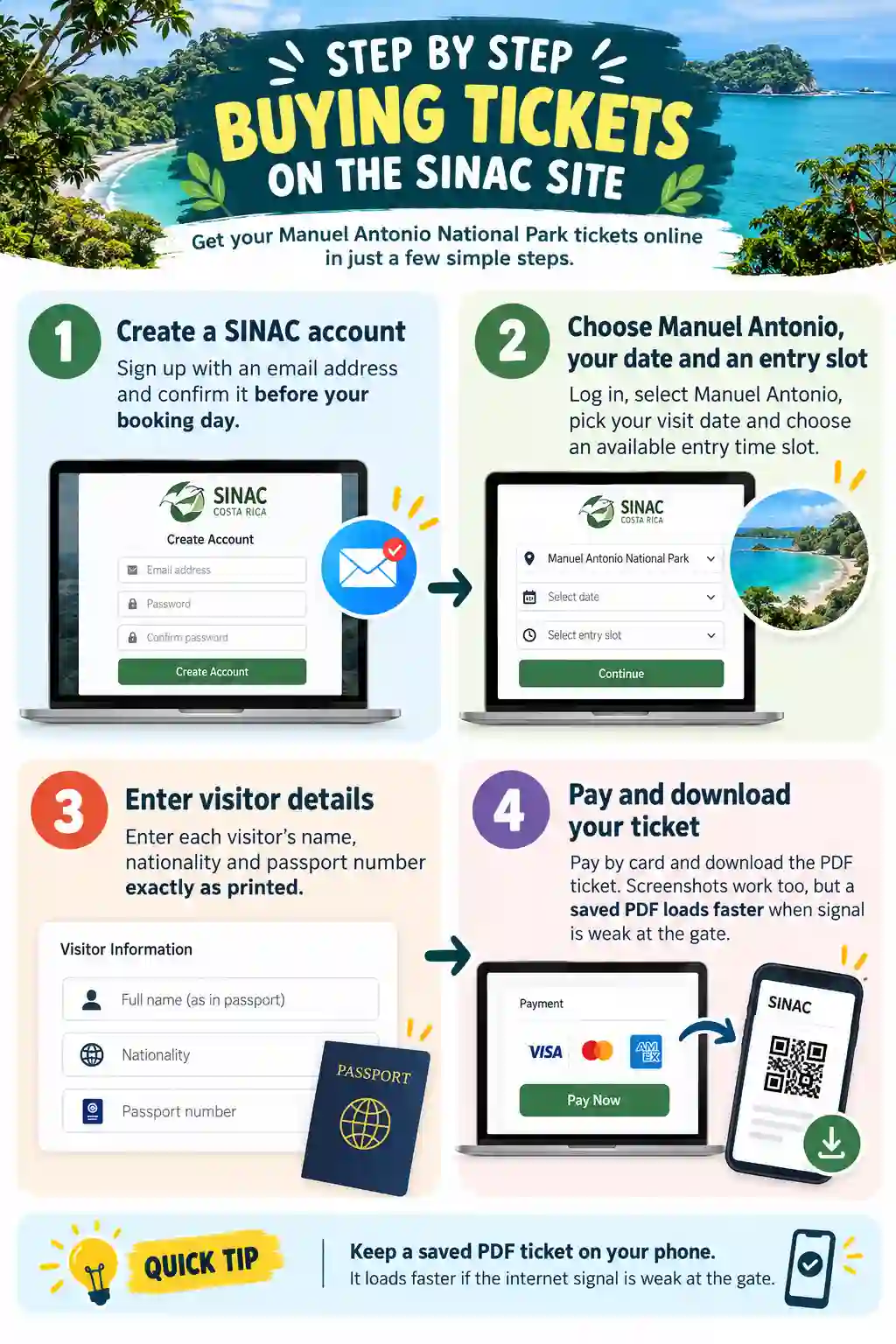
Step by step: buying tickets on the SINAC site
- Create a SINAC account with an email address and confirm it before your booking day.
- Choose Manuel Antonio, your date and an entry slot.
- Enter each visitor’s name, nationality and passport number exactly as printed.
- Pay by card and download the PDF ticket. Screenshots work, but a saved PDF loads faster when signal is weak at the gate.
One more tip: book your tickets before your hotel if you’re traveling in January or around Easter week. A sold-out park day is harder to fix than a hotel night.
Is there a Costa Rica national park pass?
No. Costa Rica doesn’t sell a single annual pass that covers all national parks for foreign visitors. Each park (Manuel Antonio, Arenal, Corcovado and so on) is booked and paid for separately on SINAC. So if you plan to visit three parks, budget for three separate tickets.
Closed on Tuesday, not Monday
Lots of older blog posts still say Monday. But the park now shuts on Tuesdays and runs 7 am to 4 pm the rest of the week, holidays included, so check the SINAC calendar before booking a hotel near Quepos.
Manuel Antonio National Park hours at a glance
| Item | Time | Note |
|---|---|---|
| Open days | Wednesday to Monday | Closed every Tuesday |
| Gate opens | 7:00 am | First entry slot is the busiest one for wildlife |
| Last entry slot | 1:00 to 2:30 pm | Leaves little time on the beaches |
| Beaches inside close | Around 3:00 pm | Rangers start clearing sand areas first |
| Park closes | 4:00 pm | Everyone must be out by closing |
How to get to Manuel Antonio, Costa Rica
Most travelers reach the park in one of three ways. Driving gives you the most freedom, especially if you plan to stop in Jacó or at the crocodile bridge. Public buses are the cheapest option. Domestic flights save the most time.
| Option | From | Rough time | Rough cost (USD) | Best for |
|---|---|---|---|---|
| Rental car | SJO airport | About 3 hours | Car plus about $5 tolls and $10 parking | Flexibility and side stops |
| Public bus | San José bus terminal | 3.5 to 4 hours | About $10 to $15 one way | Tight budgets |
| Shared shuttle | San José or SJO hotels | About 3.5 hours | About $55 to $70 per person | Travelers who don’t want to drive |
| Domestic flight | San José to Quepos airstrip | About 25 to 30 minutes | About $80 to $150 one way | Short trips with little time |
The rest of this section focuses on the drive, since that’s where most first-timers make mistakes.
The drive from San José, leg by leg
Every kilometer of this route is paved, so skip the 4×4. A small sedan or a 4×2 crossover handles it fine, and the money you save on the rental is better spent on a park guide.
Leaving SJO Juan Santamaría, you pick up Route 27 (the Caldera highway) and lose about 1,200 meters of altitude through the hills on the way to the Pacific. There are three toll booths on the descent. Last time rates were published they came to around ₡2,000 in total, which is why small colones belong in the door pocket.
Once you pass the Route 34 junction, the Costanera Sur takes over. It’s flat and quick, running through Jacó and Parrita before it reaches Quepos.
| Leg | Road | Rough distance | Rough time | What catches drivers out |
|---|---|---|---|---|
| SJO to the Route 34 junction | Route 27 | Down to the coast | About 1 hour | Tolls and weekend traffic, heading out on Friday afternoon and coming back on Sunday afternoon |
| Junction to the Tárcoles bridge | Route 34 | 11 km | 10 minutes | Signage for the bridge is poor, so watch for the restaurants on either side if you want to pull over for the crocodiles |
| Jacó to Manuel Antonio | Route 34 then Route 618 | 80 km | About 1.5 hours | Good pavement and easy driving until Quepos, where it slows down |
| Quepos to the park entrance | Route 618 | A few km over the hill | 10 to 15 minutes | A narrow, curvy road with buses forcing their way through, and it jams from 4 to 5 pm |
| Whole trip San José to the park | 27, 34, 618 | 177 km | About 3 hours with normal traffic | Leave after 1 pm and you’ll hit the Quepos hill right in the 4 to 5 pm jam |
One practical stop is Orotina, where Route 27 begins to level out. Fruit stands sit on both sides of the highway with cheap prices, which is handy if your hotel room has a kitchen.
Between Parrita and Quepos, the road runs through miles of African oil palm plantations. It’s flat, straight and tempting to speed on. Watch for bicycles and farm trucks pulling out without warning, especially around dusk.
Is a same-day round trip from San José realistic? It’s possible, but you’d have to leave the capital around 4 am to catch the 7:00 entry slot. And then you’d face Route 27 in the dark after a whole day in the heat. My advice is to book the night before in Quepos or Manuel Antonio village.
If you’d rather find a car waiting at SJO than climb onto another shuttle, Jumbocar rental a car Costa Rica operates from an agency beside the airport terminals and runs a free shuttle to it. Its quoted prices already include the mandatory insurance, and you can cancel for free up to 24 hours before pickup.
The fleet has 4×2 models like the Geely Coolray, which is plenty of car for Route 27 and the Costanera. The team answers in English 7 days a week.
[IMAGE | AI-generic | Small rental car on a paved coastal highway lined with palm trees | Small white rental car driving along a paved tropical highway with palm trees]
Manuel Antonio National Park parking and the people in fake uniforms
Manuel Antonio has no official parking lot. Every lot along the access road is private, and a few dress their staff in ranger-style shirts or put up signs that look government-issued.
Real rangers only work inside the park. So the guy waving you over on the road, offering parking, a tour or “the last tickets of the day,” is selling you something you don’t need. Slow down, smile, keep rolling.
With the beach on your right, drive on until the Marlin restaurant appears on your left. You can turn there or continue to the lots just before the path to the gate (the road dead-ends in a U-turn, so missing a spot only costs you one loop). Plan on about $10 or ₡4,000 for the day, paid in cash. And leave nothing on the seats.
Staying in Manuel Antonio village? Many hotels run a free shuttle down the hill, and the local Quepos to Manuel Antonio bus stops close to the entrance path. Either option means no parking fee at all.
The Manuel Antonio National Park entrance: what to expect
From the parking area, a short walk on a paved lane leads to the entrance gate. Expect a line at the 7:00 slot. Rangers scan your ticket, check passports, then search bags at a table just inside.
After the check, the wide main trail (Sendero Principal) heads into the forest. Most guided groups stop along this first stretch, because it’s where sloths are most often spotted. If you’re walking alone, follow the cluster of spotting scopes.
What you can and can’t carry in
Staff check bags at the entrance, and at Manuel Antonio they actually open them. Food stays out, along with single-use plastic (disposable water bottles count), cigarettes, drones and pets.
Pack a refillable bottle, because there are refill stations inside, plus a swimsuit, sunscreen and repellent. For lunch you buy from the cafeteria in the middle of the park and eat it right there. That rule exists so the capuchins don’t learn to raid backpacks.
This is what goes in the car the night before.
- Printed or downloaded SINAC ticket showing your time slot
- Passports for everyone named on the ticket
- Colones in small bills for tolls and parking
- Refillable bottle, swimsuit, towel and closed shoes for the trails
- Breakfast eaten before 7, because nothing is available until the cafeteria
Manuel Antonio National Park map: trails and beaches explained
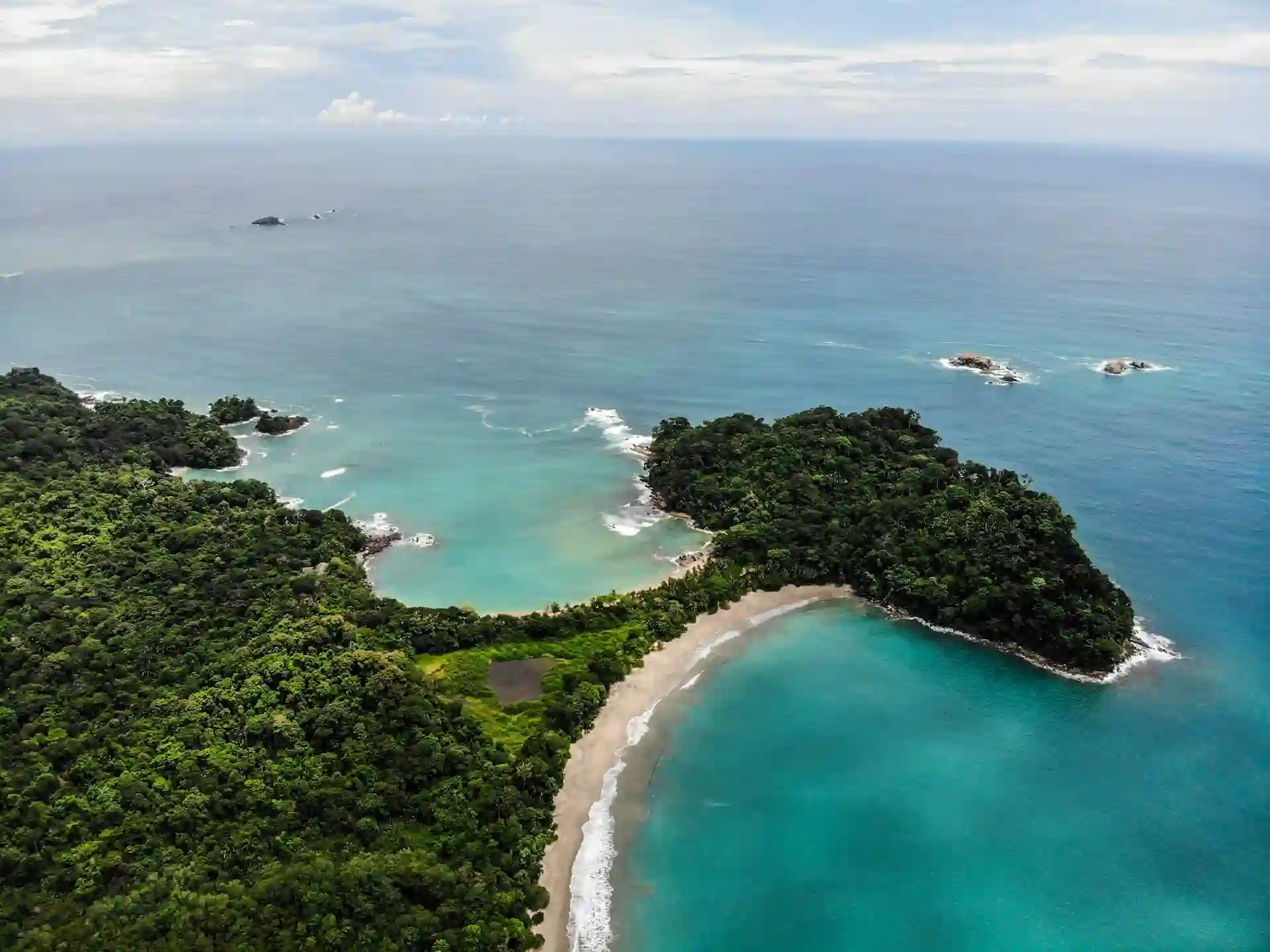
The park is small enough to walk most of it in half a day. Think of the trail map as one main spine with short branches off it. Every branch ends at a beach or a lookout.
| Trail | Rough length | Difficulty | What you’ll find |
|---|---|---|---|
| Sendero Principal (main trail) | About 2 km | Easy, flat | Wide path, best sloth sightings, leads to the central beaches |
| Punta Catedral loop | About 1.4 km | Moderate, stairs | Loop around the headland with ocean viewpoints |
| Sendero Mirador | About 1.3 km | Moderate to hard, steep stairs | Lookout over Puerto Escondido and the coast |
| Sendero Manglar (mangrove) | Short boardwalk | Easy | Mangrove forest, crabs, raccoons |
| Playa Gemelas trail | Short spur | Easy | Two small, quieter coves |
The beaches inside are Playa Manuel Antonio (the calm, curved one most photos show), Playa Espadilla Sur, Playa Gemelas and Playa Puerto Escondido. Rangers close certain trails after heavy rain, so check the board at the entrance for that day’s open routes. (SINAC)
A practical tip on the Manuel Antonio map: there’s no reliable printed map handed out at the gate. Screenshot the map from SINAC or take a photo of the sign at the entrance before you set off.
Hiking Manuel Antonio: which route to pick
If you only have three hours, walk the main trail with your guide, branch to Playa Manuel Antonio, then do the Punta Catedral loop. That covers the best wildlife and the best views. Save the Mirador stairs for cooler morning hours, because the climb is steep and humid.
Guide or no guide?
That depends on why you came. Sloths stay high and barely move, and a guide with a spotting scope will find one long before you do, often while you’re standing right underneath it without a clue.
Most guided walks run 2 to 3 hours, and afterward you’re free to stay inside alone until closing. Is this the only wildlife park on your itinerary? Then pay for the guide.
But if you’ve already walked Monteverde or Tortuguero with one, skip it. Go slow on the trails and you’ll still get monkeys, iguanas and agoutis. Before handing over cash, ask whether the tour price covers the entrance ticket, because plenty of them don’t.
How to choose a Manuel Antonio guided tour
A Manuel Antonio National Park tour typically costs about $30 to $65 per person for a shared group, plus the entrance fee if it isn’t included. Private tours cost more but move at your pace, which helps with kids.
Look for guides who carry an ICT (Costa Rica Tourism Board) certified guide ID. Book through your hotel or a local operator in advance, rather than with someone who approaches you on the road. Groups of 8 or fewer are easier to manage around a single spotting scope.
Wildlife you’re likely to see
Common sightings include white-faced capuchin monkeys, mantled howler monkeys, two-toed and three-toed sloths, white-nosed coatis, agoutis, green and black iguanas, and raccoons near the beaches. The park is also home to the Central American squirrel monkey, which lives only on this stretch of Pacific coast. (SINAC)
Never feed any of them. Capuchins and raccoons near Playa Manuel Antonio will open unzipped bags in seconds, so keep everything closed while you swim.
Manuel Antonio National Park photos: where to get the best shots
The classic photo is the curve of Playa Manuel Antonio, with jungle hanging over turquoise water. Shoot it from the north end of the beach before 9 am, when the sand is still mostly empty.
For a wider view, the Punta Catedral loop has openings over the headland and the rocky islands offshore. Wildlife photos need patience more than gear. A phone held against a guide’s spotting scope gets surprisingly sharp sloth photos, and most guides will help line it up.
Two quick photo rules: never use flash on animals, and don’t step off the trail for a closer shot. Rangers enforce both.
Why Tuesday makes a good driving day?
The park is closed anyway, so spend Tuesday on the road. Leave San José in the morning and check in at Quepos by early afternoon.
And while there’s still light, go find the Marlin turn. On Wednesday at 7 you’ll pull up to the gate with nothing left to figure out.
How we researched this guide: we used SINAC’s official park and ticketing information, Costa Rica Tourism Board (ICT) guidance, and published toll and road information for Routes 27 and 34.
Frequently asked questions
How much is the entrance fee to Manuel Antonio?
Foreign adults pay about $18 with tax included. Kids from 2 to 12 come in around $5.65, and you settle the bill on the SINAC website when you book (the gate won’t take your money).
Can I buy Manuel Antonio tickets at the gate?
No. Tickets for Manuel Antonio park are sold online only through SINAC. Book with each visitor’s passport number, since rangers match the ticket to your ID. In high season, slots can sell out weeks ahead, so buy as soon as your dates are set.
What are Manuel Antonio National Park hours?
The park is open 7 am to 4 pm, Wednesday through Monday, and closed on Tuesdays. Beaches inside close earlier, around 3 pm. Hours can change for holidays or weather, so check the SINAC calendar before your visit.
When is the best time to go to Manuel Antonio National Park?
The dry season runs roughly December to April and gives you the most reliable weather. But late December, January and February also bring the heaviest crowds, so whatever month you pick, book the 7:00 am slot.
How long does it take to drive from San José to Manuel Antonio?
Count on about 3 hours for the 177 km. You take Route 27, then Route 34 down through Jacó, and a weekend on Route 27 can stretch that a lot.
What airport do I fly into to get to Manuel Antonio?
Most people coming from abroad land at SJO Juan Santamaría near San José and drive the rest. Small domestic planes fly San José to Quepos several times a day too, though you’ll still need a ride from the Quepos airstrip to the park.
How many hours do you need in Manuel Antonio National Park?
Plan for 3 to 4 hours. That covers a 2-hour guided walk on the main trail, a swim at Playa Manuel Antonio and the Punta Catedral loop. Staying until closing works well if you arrive at 7 am and want quiet beach time.
Is a guided tour worth it in Manuel Antonio?
Yes, for most first-time visitors. Guides carry spotting scopes and know where sloths and squirrel monkeys rest that week. Without one, you’ll still see capuchins and iguanas, but you’ll likely miss the animals high in the canopy.
Is Manuel Antonio National Park safe?
Yes. Trails are busy, well marked and patrolled by rangers. The real risks are minor: theft from unattended bags on the beaches, slippery steps after rain and strong rip currents on Playa Espadilla outside the park. Lock valuables away and swim only where it’s calm.
Can you bring food into Manuel Antonio National Park?
No. Rangers search bags and remove food, snacks and disposable plastic bottles. You can buy lunch at the cafeteria inside the park and eat it there. Bring a refillable bottle, since water refill stations are available on the main trail.